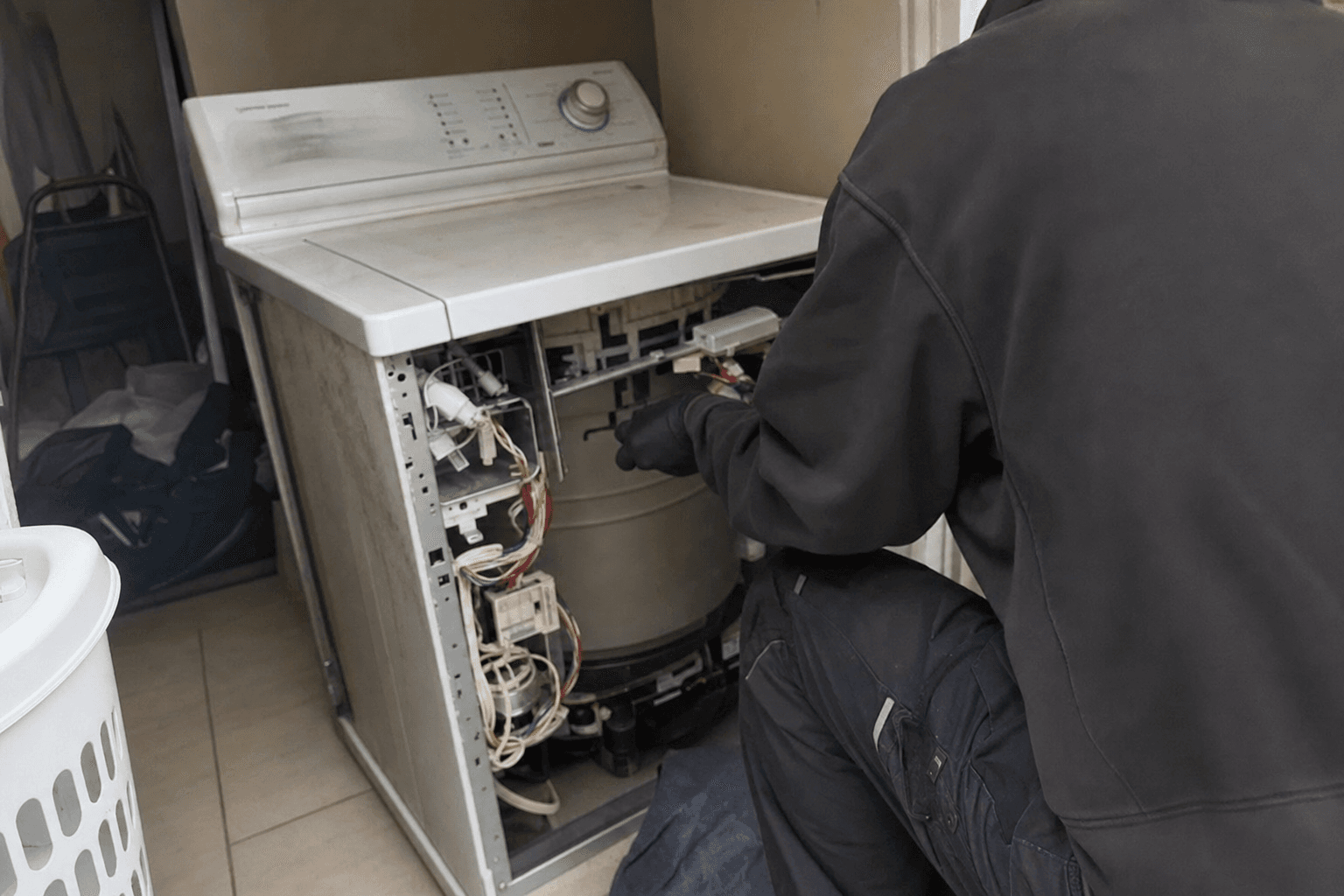
Why your washing machine won't start and what to check first
A washer that is dead or won't start often has a simple cause. Here is what to check, in order, before you decide whether to book a repair.
Key takeaways
- Check the outlet, breaker and plug before anything else.
- A door or lid that doesn't register as closed stops many washers from starting.
- Damp basements and garages in Vancouver can trip outlets in the fall.
- Unplug the machine before you look at anything behind the panel.
- Most repairs in Metro Vancouver run $180 to $420 depending on the part.
A washer that won't start is stressful, especially with a full basket and a wet week ahead. The cause is often simple. Work through the checks below in order. Most take a few minutes and none need tools.
Start with power
The first question is whether the machine has any power at all. Look at the control panel. If nothing lights up and nothing beeps, the problem is likely upstream of the machine.
Check these in order.
- Make sure the plug is fully in the wall. Machines get nudged when you clean behind them.
- Plug a lamp or phone charger into the same outlet to confirm it works.
- Look at your electrical panel for a tripped breaker. It may sit halfway between on and off.
- If the outlet has a reset button, press it.
In Vancouver, many washers sit in basements, laneway houses and detached garages off the lane. Those spaces can be damp from October to April. Moisture can trip a protected outlet, so the reset button is worth a try in a basement suite or garage laundry.
Do not reset a breaker over and over. If it trips again right away, leave it off and stop. That points to a fault in the machine or the wiring.
Check the door or lid
A washer will not start a cycle unless it believes the door or lid is closed. The latch or lid switch tells it so. If that part is worn, the machine may do nothing when you press start.
Close the door firmly and listen for a click. Check that no sock, strap or bit of clothing is caught in the seal. On a top loader, press down on the lid while you press start. If the machine starts only when you hold the lid down, the lid switch is likely failing.
On a front loader, a door that clicks but does not lock is a common sign of a worn latch. Some machines will beep or show an error code when this happens.
Check the control settings
Some machines lock the controls, and many have a child lock. It is easy to trigger by accident. Look for a padlock symbol or a message on the display. The manual will tell you how to switch it off, usually by holding one button for a few seconds.
Also check that you have chosen a full cycle. Some machines need you to press start and hold it for a moment. Others pause if you open the door mid-cycle and need a second press.
If the display shows an error code, write it down. It narrows the problem quickly. Look it up in your manual or on the manufacturer's site.
Try a simple reset
If the machine has power but acts confused, try a reset.
- Unplug the washer.
- Leave it unplugged for several minutes.
- Plug it back in and try a short cycle.
This can clear a stuck control board. It will not fix a failed part, but it rules out a glitch. If a reset works once and the problem returns, the board or a sensor may be on its way out.
Special cases in strata buildings
A big share of Vancouver households live in strata buildings. If you rent or own a condo in Mount Pleasant, Kitsilano or Marpole, other things can matter.
- Some shared laundry rooms have their own breakers, and those are not always yours to reset.
- Strata bylaws may limit who can work on in-suite appliances or when.
- A power fault in the unit may need your strata manager or an electrician before the machine is blamed.
If other outlets in the same room are also dead, the problem is the circuit and not the washer. In character houses in Kerrisdale and Dunbar, older wiring can also play a part. Keep that in mind if the outlet seems weak or warm.
What usually fails
If the outlet, breaker, latch and settings all check out, a part inside the machine has likely failed. Common causes include a door latch or lid switch, a power cord, a thermal fuse or a control board. You can't tell which one by looking from the outside.
Unplug the machine before you take off any panel. Water and electricity sit close together in a washer, and a quick look is not worth a shock.
What a repair costs
Most washing machine repairs in Metro Vancouver run $180 to $420 all-in, depending on the part. A latch or switch tends to sit toward the lower end. A control board is usually higher. Your technician should give you the exact price before any work starts.
With us, you get an upfront quote on site. You don't pay unless we fix it, although a service call fee applies. Every repair carries a 90-day parts warranty and a 7-day satisfaction guarantee on the workmanship.
If the machine is old and the quote is near the price of a new one, it is fair to weigh the two. A good technician will tell you plainly if a repair does not make sense.
When to call a professional
Call a technician if the machine has power but will not start after the checks above, if a breaker trips again, or if you smell burning or see scorch marks near the plug. Stop using the machine in those cases. If you have a full load of wet laundry and cannot wait, we offer same-day visits when available, and our technicians are licensed and insured. If the fix turns out to be a tripped outlet in your own wiring, we will tell you, and you can call an electrician.
Need a hand from a real technician?
Our licensed pros repair washers and dryers across Metro Vancouver — same-day and next-day, with 90-day parts warranty + 7-day satisfaction guarantee.
Keep reading
How often should you clean your dryer vent?
Most homes need a dryer vent cleaning once a year. Long runs, multi-unit buildings and heavy laundry loads mean every 6 to 9 months. Here is how to tell which you are.
How do you check and clean a blocked dryer vent?
A blocked dryer vent wastes power and is a fire risk. Here is how to spot one, how often to clean it, and how to clear an easy run yourself.