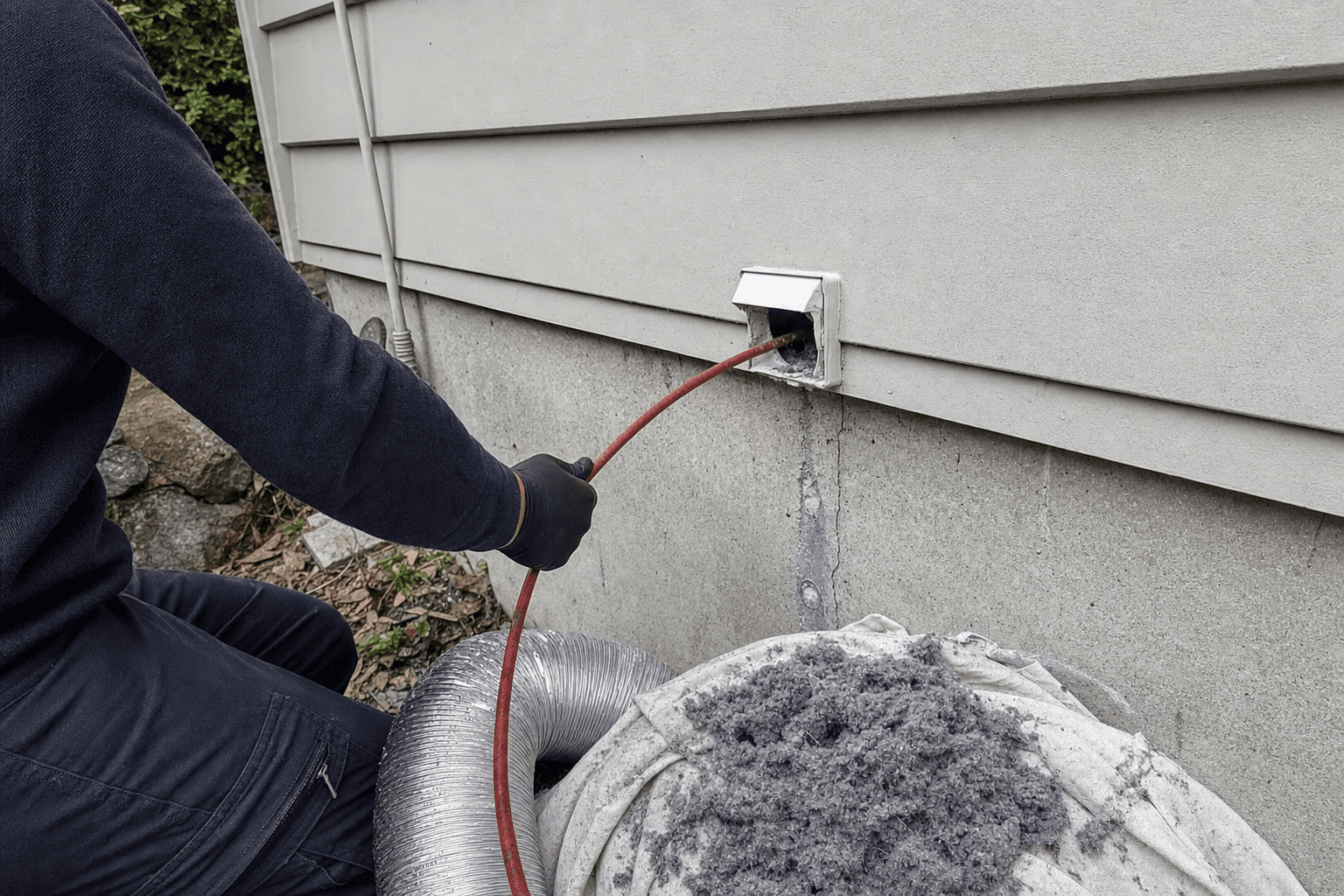
How often should you clean your dryer vent?
Most homes need a dryer vent cleaning once a year. Long runs, multi-unit buildings and heavy laundry loads mean every 6 to 9 months. Here is how to tell which you are.
Key takeaways
- Once a year is the baseline for most Metro Vancouver homes.
- Long basement runs, multi-unit buildings and five or more loads a week call for every 6 to 9 months.
- A blocked vent is the leading cause of dryer fires and adds 15 to 30 per cent to your power bill.
- Two-cycle drying, a stiff exterior flap, a hot dryer or lint outside mean clean it now.
The short answer
Most homes in Metro Vancouver should have the dryer vent cleaned once a year. Some homes need it more often, every 6 to 9 months.
The reason is simple. Lint builds up inside the duct. Over time it restricts airflow. A blocked vent is the leading cause of dryer fires, and it adds 15 to 30 per cent to your electricity bill because the dryer runs longer to do the same job.
This is useful to know in November. The rain is steady, and a lot of laundry that might hang outside in summer goes into the dryer instead.
When once a year is not enough
Clean every 6 to 9 months if any of these describe your home.
- You have a long vent run, such as a dryer in the basement with a duct that travels a long way to an outside wall.
- You live in a multi-unit building, where vent runs tend to be longer and shared with other parts of the structure.
- Your household does five or more loads a week.
If two of those apply, lean toward the shorter end of the range.
What this looks like in West Vancouver
West Vancouver is mostly large detached homes on big, often steep lots. That affects vents more than people expect.
In the British Properties and Caulfeild, the laundry room is often on a lower level or in a basement. The duct may have to travel a long way, and it may have several bends, before it reaches an outside wall. A longer run holds more lint and moves air less well.
In Ambleside and Dundarave, many buildings are older low-rise condos. If you are in a multi-unit building, you fall into the 6 to 9 month group.
Waterfront homes from Ambleside to Horseshoe Bay get salt air. Salt air is hard on metal, so it is worth looking at the outside hood and flap now and then, not only the duct.
Homes higher up, around the British Properties and Cypress Park, get more rain and sometimes snow. Wet weather and snow can affect how well the outside flap opens, so check it after a storm.
Signs you should clean the vent now
Do not wait for the calendar if you see any of these.
- The dryer takes two or more cycles to dry a load. This is the most common sign. Air cannot get out, so damp air stays in the drum.
- The outside vent flap barely opens. When the dryer is running, the flap should lift with the airflow. If it only twitches, something is restricting the duct or the hood.
- The dryer surface is very hot to the touch. Heat that cannot leave the duct stays in the machine.
- There is visible lint at the exterior vent. Lint around the hood means it is moving through the duct and catching on the way out.
Any one of these is enough. Two or three together mean the vent should be cleaned before you use the dryer much more.
A quick check you can do yourself
You can learn a lot in a few minutes.
Step 1: Go outside while the dryer runs
Start a load and stand at the exterior vent. You should feel a steady push of warm air and see the flap open fully. Weak airflow points to a blockage.
Step 2: Look at the hood
Check for lint, nesting material, or a flap that is stuck, bent or corroded. On a steep lot, the vent may be hard to reach. Do not climb a slope or a ladder in wet conditions to get a look.
Step 3: Check the duct behind the dryer
Turn the dryer off and unplug it before you move it. Look at the duct for crushed sections, loose joints or sagging runs. A kinked or squashed duct restricts air the same way lint does.
Step 4: Clean the lint trap every load
This does not replace vent cleaning. It does keep more lint out of the duct in the first place.
What cleaning the vent involves
A full cleaning clears the duct from the dryer to the outside, and the exterior hood. The goal is a clear path for air from start to finish.
With a short, straight run, a careful homeowner can do some of this with a vent brush kit. With a long run, several bends, or a vent that exits high on a wall, it is harder to do well. Lint left in the middle of a long run is the lint that causes problems later.
Why it costs more to wait
A blocked vent makes the dryer work harder. That 15 to 30 per cent added to your electricity bill is an ongoing cost, and it shows up every month. A dryer that runs hot and long also wears out its parts sooner.
The larger risk is fire. Lint is dry and burns easily, and a blocked duct holds heat. That is why the leading cause of dryer fires is a blocked vent.
When to call a professional
Call someone if the dryer still takes two cycles after you have cleaned the lint trap, if the flap barely opens, or if the vent run is long enough that you cannot reach all of it. The same goes if the dryer is very hot to the touch. Stop using it until it is checked.
We repair washers and dryers across Metro Vancouver, including West Vancouver. We give an upfront quote on site, and if we do not fix it you do not pay, though a service call fee applies. If you are not sure whether the problem is the vent or the dryer itself, we can tell you which it is.
Need a hand from a real technician?
Our licensed pros repair washers and dryers across Metro Vancouver — same-day and next-day, with 90-day parts warranty + 7-day satisfaction guarantee.
Keep reading
Why your washing machine won't start and what to check first
A washer that is dead or won't start often has a simple cause. Here is what to check, in order, before you decide whether to book a repair.
How do you check and clean a blocked dryer vent?
A blocked dryer vent wastes power and is a fire risk. Here is how to spot one, how often to clean it, and how to clear an easy run yourself.