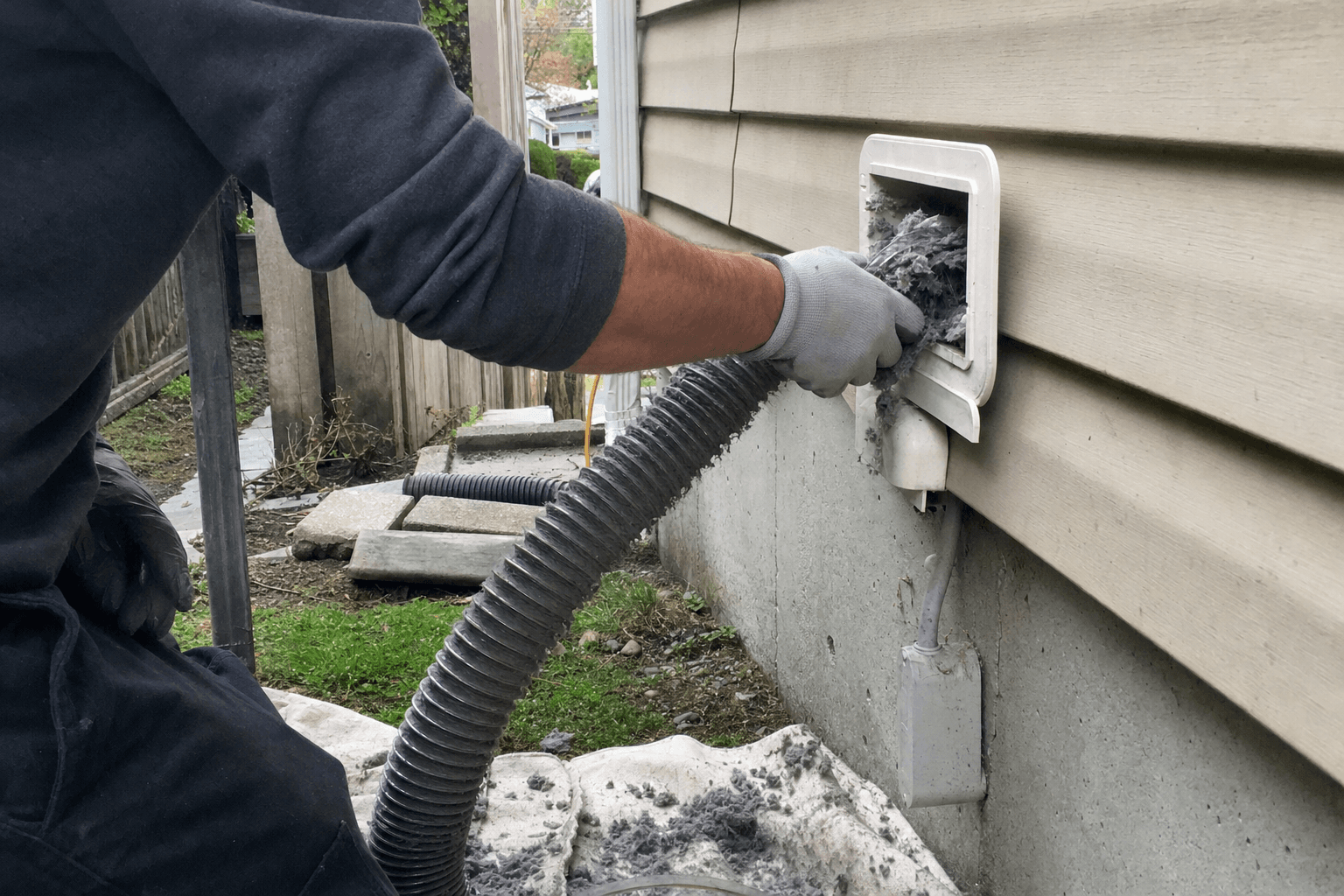
How do you check and clean a blocked dryer vent?
A blocked dryer vent wastes power and is a fire risk. Here is how to spot one, how often to clean it, and how to clear an easy run yourself.
Key takeaways
- Four signs point to a blocked vent: slow drying, a stiff flap, a hot dryer and lint outside.
- Clean once a year, or every 6–9 months for long runs, multi-unit buildings or heavy use.
- A blocked vent is the leading cause of dryer fires and adds 15–30% to your electricity bill.
- Unplug the dryer first, and leave gas dryer connections to a professional.
- Cleaning the lint screen alone does not clear the duct behind the dryer.
Why a blocked dryer vent matters
Your dryer pushes hot, damp air out of the house through a duct. Lint builds up inside that duct over time. When airflow drops, the dryer works harder and runs hotter.
A blocked vent is the leading cause of dryer fires. It also adds 15–30% to your electricity bill. That makes it worth checking, even if the dryer still seems to work.
In November, most Port Coquitlam households run the dryer more. Wet weather keeps laundry off the line, and the Coquitlam and Pitt rivers keep the air damp through winter. A vent that was marginal in summer can become a real problem now.
Signs your dryer vent is blocked
These are the symptoms we see most often.
- The dryer takes two or more cycles to dry a load.
- The outside vent flap barely opens when the dryer runs.
- The dryer surface is very hot to the touch.
- You can see lint at the exterior vent.
One sign on its own is a reason to look. Two or more together almost always mean the duct needs cleaning.
A quick check you can do in five steps
This takes very little time and needs no tools.
- Clean the lint screen and run the dryer on a normal heat setting.
- Go outside and find the exterior vent.
- Hold your hand near the flap. You should feel a strong, steady push of warm air.
- Watch the flap. It should open fully, not just flutter.
- Look for lint caught in the flap or on the wall around it.
Weak airflow or a stiff flap means something is restricting the duct.
How often to clean a dryer vent
Most Metro Vancouver homes should have the vent cleaned once a year. Some homes need it more often. Clean every 6–9 months if any of these apply.
- The vent has a long run, such as from a basement laundry to an outside wall.
- You live in a multi-unit building.
- Your household does five or more loads a week.
This matters in Port Coquitlam because of the housing. Split-levels and basement-entry houses are common in Glenwood, Lincoln Park and Mary Hill. Laundry in those homes is often downstairs, and the duct may have to travel a fair distance to reach an outside wall. Longer runs collect more lint.
Low-rise condos near Downtown Port Coquitlam fall into the multi-unit group. If your building has shared venting or a management company, ask who is responsible for the duct before you start work.
Newer hillside homes in Citadel Heights and Oxford Heights are not exempt. Newer does not mean shorter. Check where your dryer sits and how far the duct travels.
North-side neighbourhoods near the hills stay shaded and damp longer. An exterior vent there can stay wet, and damp lint packs tighter around the flap. Look at it more often through winter.
How to clean a dryer vent yourself
If your dryer is easy to move and the duct run is short, you can clear it yourself. Take your time and go slowly.
What you need
- A vacuum with a hose attachment
- A flexible dryer vent brush
- A screwdriver or nut driver for the duct clamp
- Gloves
Steps
- Unplug the dryer.
- Pull the dryer out far enough to reach the back. Move it gently so you do not kink the duct.
- Loosen the clamp and detach the duct from the back of the dryer.
- Vacuum the lint from the dryer outlet and from the duct.
- Push the brush through the duct from the dryer side, then from the outside vent if you can reach it.
- Clear the exterior flap and remove any packed lint around it.
- Reconnect the duct, push the dryer back and run it. Check the flap again for a strong push of air.
If you have a gas dryer, do not disconnect or move the gas line yourself. Leave that to a professional.
Check the duct itself
Look at the duct material while you have it off. Crushed, sagging or kinked sections hold lint and slow airflow. Replace damaged duct rather than cleaning it again and again.
What cleaning the lint screen does not fix
Emptying the lint screen after each load is good habit. It does not clear the duct behind the dryer. Fine lint gets past the screen and settles in the vent.
If you have cleaned the vent and the dryer is still slow or very hot, the problem may be somewhere else. A failing heating element, thermostat or sensor can cause similar symptoms. That is a repair, not a cleaning job.
When to call a professional
Call if the duct is long, hard to reach or runs through a finished wall or ceiling. Call if you have a gas dryer, or if the dryer is still hot and slow after you have cleared the vent. We repair washers and dryers across Metro Vancouver, including Port Coquitlam, and our technicians are licensed and insured. We quote upfront on site, and you do not pay unless we fix it, though the service call fee applies.
Need a hand from a real technician?
Our licensed pros repair washers and dryers across Metro Vancouver — same-day and next-day, with 90-day parts warranty + 7-day satisfaction guarantee.
Keep reading
Why your washing machine won't start and what to check first
A washer that is dead or won't start often has a simple cause. Here is what to check, in order, before you decide whether to book a repair.
How often should you clean your dryer vent?
Most homes need a dryer vent cleaning once a year. Long runs, multi-unit buildings and heavy laundry loads mean every 6 to 9 months. Here is how to tell which you are.