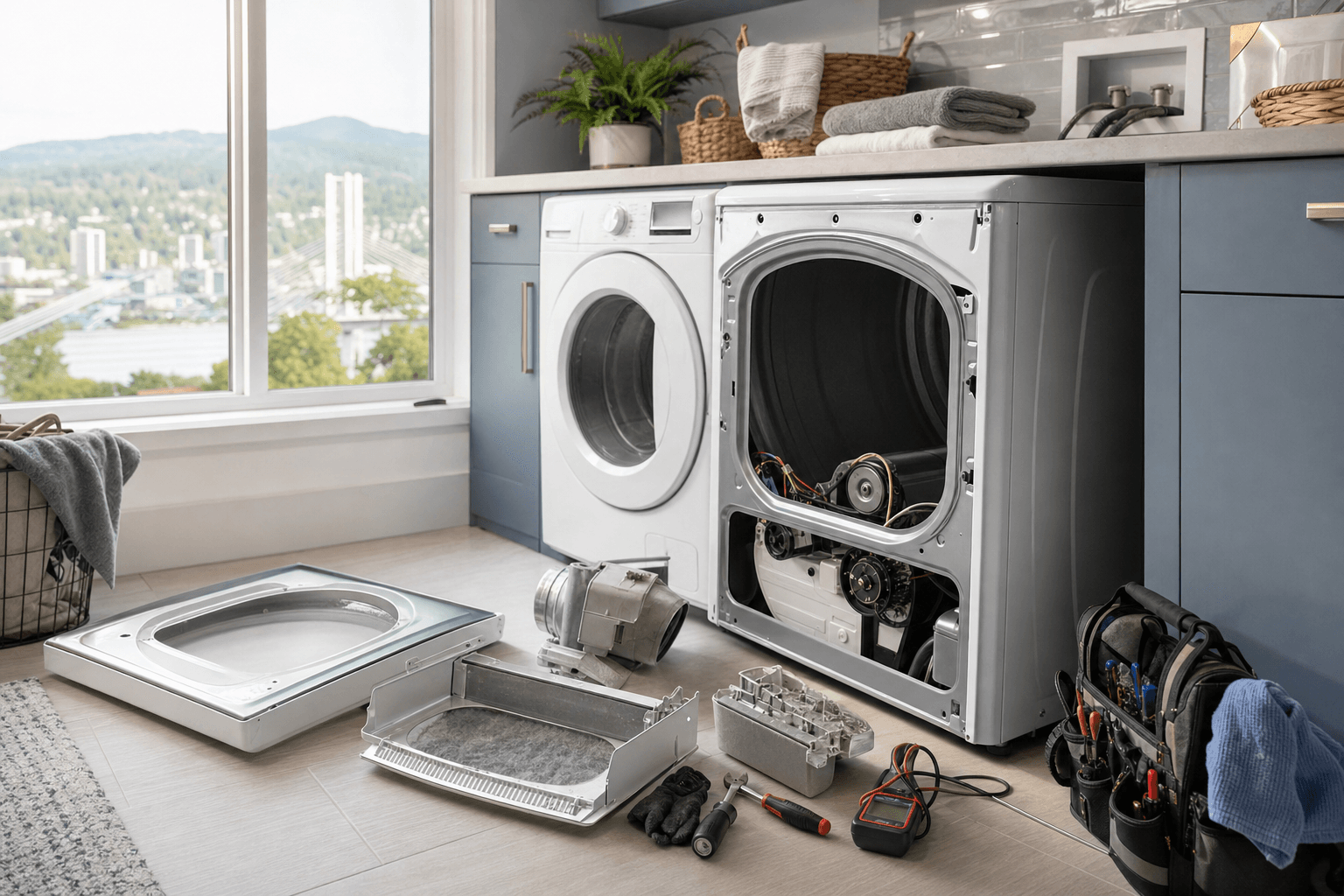
Why won't my dryer start, and what can you check before calling for repair?
A dryer that won't start or won't tumble usually has a power, door switch, or safety fuse problem. Here is what to check in order, what it costs, and when to call.
Key takeaways
- Check the breaker, plug, and door latch first. They cost nothing and fix many no-start calls.
- A hum with no tumbling points to a belt or motor. Total silence points to power, a switch, or a fuse.
- A blown thermal fuse often means the vent is clogged, so replacing the fuse alone may not last.
- Most Metro Vancouver dryer repairs run $180 to $380 with parts, quoted upfront before work starts.
Short answer
A dryer that won't start is usually a power problem, a door problem, or a failed safety part. Start with the simple checks. If they don't help, the cause is often a door switch, a thermal fuse, a start switch, a drive belt, or a motor.
In November the dryer works hard. Wet coats, towels, and bedding pile up. A fault you ignored in summer tends to show itself now.
Check the power first
Most dryers use a double breaker. One side can trip while the other stays on. The breaker may look fine at a glance, so switch it fully off and back on.
Work through these in order.
- Check that the plug is fully pushed into the outlet. Dryers get nudged when the machine is moved for cleaning.
- Look at the breaker panel for a breaker sitting halfway between on and off.
- Check whether the control panel lights up at all. No lights at all points to power or a failed fuse.
- Try another appliance in the same area only if it uses a normal outlet. Do not test the dryer outlet with anything else.
If you live in an older Victorian or Edwardian home in Queen's Park or Sapperton, the dryer may sit in a basement or back room, and the panel may be some distance away. Check the panel nearest to it and any sub-panel. Condo owners in Uptown and Downtown should look at the panel inside their own unit.
Check the door and the load
A dryer will not start if it thinks the door is open. The door switch is a small part, and it wears out.
Press the door shut firmly and listen for a click. Look at the latch for a bent or loose catch. Make sure a sleeve or sock isn't caught in the gap.
Also check that the load isn't too big. An overstuffed drum can stop the dryer from turning, and it can trip the motor's overload protection. Pull half the load out, wait a few minutes, and try again.
Listen to what it does when you press start
What you hear tells you a lot.
Total silence
Nothing happens and the lights may be off. This points to power, a blown thermal fuse, a failed door switch, a faulty start switch, or a control board problem.
A hum, but the drum doesn't turn
The motor is getting power but can't turn the drum. A snapped drive belt is the most common cause. A worn drum roller or a seized motor can do the same thing. Try turning the drum by hand with the power off. If it spins freely with no belt resistance, the belt has likely broken.
A click, then nothing
This can be a start relay, a start switch, or a motor that has failed. It is worth a technician's look.
What usually fails
These are the parts behind most no-start calls.
- Door switch. Cheap part, common fault.
- Thermal fuse. A safety fuse that blows when the dryer overheats. On many models a blown fuse stops the whole dryer, not just the heat.
- Drive belt. The motor runs, but the drum stays still.
- Start switch. The button or switch no longer completes the circuit.
- Motor. The costliest of the group, and less common.
Why a blown thermal fuse needs a second look
A thermal fuse blows for a reason. The most common reason is a clogged vent line. Hot air can't leave the dryer, the temperature climbs, and the fuse cuts power.
If you replace the fuse and leave the vent blocked, the new fuse can blow too. Lint buildup, a crushed vent hose behind the machine, or a blocked outside hood can all be the cause.
This matters in New Westminster, where many condos and townhouses have long or tight vent runs. In Queensborough, newer houses and townhouses may have vent routes through upper floors. A technician should check airflow before calling the job done.
What you should not do
Don't open the back or top panel with the dryer plugged in. Don't bypass a door switch or a thermal fuse to make the dryer run. Those parts exist to prevent overheating and fire.
If you smell burning or see scorch marks, unplug the dryer and stop using it.
What a repair usually costs
Most dryer repairs in Metro Vancouver run $180 to $380 with parts. A door switch or belt sits toward the lower end of that range. A motor or control board sits toward the upper end.
We give you an upfront quote on site before any work starts. You don't pay unless we fix it, though a service call fee applies. Every repair carries a 90-day parts warranty and a 7-day satisfaction guarantee on the workmanship.
When to call a professional
Call a technician if the breaker, plug, and door checks don't help, or if the dryer hums but won't turn. Call if a thermal fuse has blown more than once, or if you can't tell whether the vent is clear. Anything involving the back panel, wiring, or a burning smell is a job for a licensed, insured technician. We are open 7 days, and we offer same-day visits when available.
Need a hand from a real technician?
Our licensed pros repair washers and dryers across Metro Vancouver — same-day and next-day, with 90-day parts warranty + 7-day satisfaction guarantee.
Keep reading
Why does my dryer take more than one cycle to dry a load?
A dryer that needs two or three cycles usually has an airflow problem first and a weak heat problem second. Here is what to check, in order, and what a repair costs.
Can you run a dryer in a cold garage during a BC winter?
Most dryers can run in an attached garage in winter if the manual allows it. Cold slows drying and stresses the vent, so a few checks matter before the first frost.