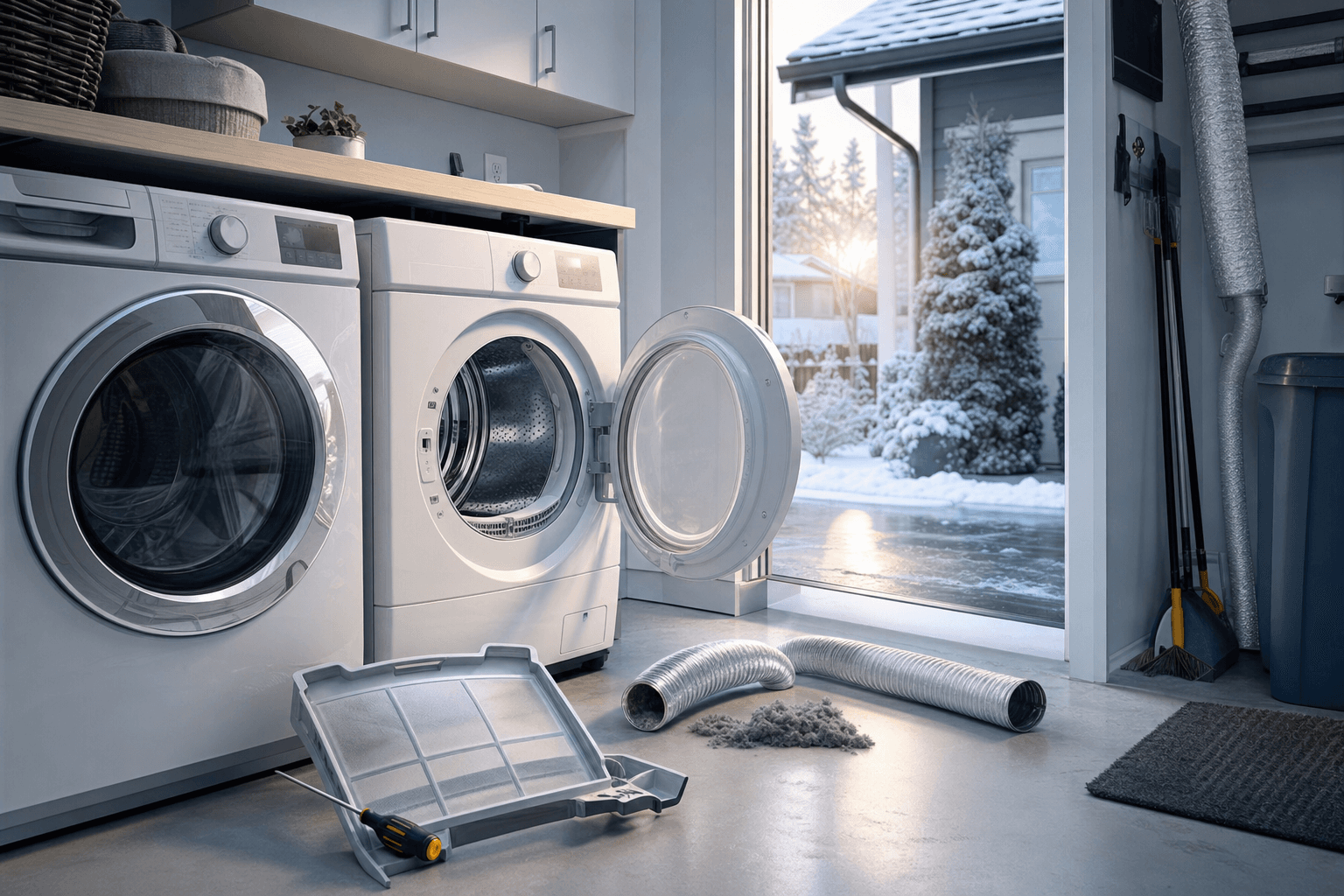
Can you run a dryer in a cold garage during a BC winter?
Most dryers can run in an attached garage in winter if the manual allows it. Cold slows drying and stresses the vent, so a few checks matter before the first frost.
Key takeaways
- Check your dryer manual for its allowed operating temperature before you leave it in a cold garage.
- Cold air and a cold vent line slow drying and let damp lint build up faster.
- Look at the outside vent hood after frost, wind, or heavy evergreen needle fall.
- Keep paint, fuel, and solvents well away from the dryer, especially in a garage.
- Longer cycles, no heat, or mid-cycle shutoffs are signs to get the vent and heating parts checked.
Short answer
Most homeowners can run a dryer in an attached garage in winter. The dryer will work harder, though, and a few small problems show up more often once the nights turn cold.
This matters in Langley. Further inland, winter nights are colder and frost and snow are more common than in the coastal cities. Many newer strata townhouses in Willoughby and Yorkson have the laundry in or beside an attached garage, so the question comes up a lot.
Check the manual first
Every dryer manual lists the conditions the machine is built to run in. Some models say they need a heated space. Others allow a wider range. Look for the section on installation location or operating temperature.
If the manual says the machine needs a heated space, a cold garage can shorten its life and may cause it to behave oddly. If the manual is gone, the model number on the label inside the door usually lets you find a copy online.
What cold does to a dryer
A dryer pulls in room air, heats it, and pushes it through the drum and out the vent. In a cold garage, that incoming air starts out cold and often damp. The heating element has more work to do, so cycles run longer.
Cold can also affect these parts:
- Vent line. Warm, wet air meets a cold duct and cools quickly. Moisture condenses inside, and damp lint sticks to the walls instead of blowing out.
- Outside hood. The flap can stick closed with frost or ice. Air then has nowhere to go.
- Drum bearings and rollers. Cold can stiffen old grease. You may hear squeaking for the first few minutes of a cycle that fades as the machine warms up.
- Laundry. Wet clothes left in a cold dryer between loads stay damp and can smell musty.
Local factors in Langley
Trees matter here. Brookswood and Fernridge have heavy evergreen cover on many lots. Needles, small twigs, and moss can collect around an outside vent hood and in the flap. In autumn rain, that debris gets wet and packs down.
In Walnut Grove and Brookswood, many 1980s and 1990s homes have vent runs that were routed years ago and may be long or have several bends. A longer run gives moisture more time to condense in cold weather.
In newer strata townhouses, the vent often goes straight through a garage wall. That is a short run, which helps. Check your strata rules before you change anything on an exterior wall or hood, since the strata may be responsible for it.
Checks to do this month
A few minutes now can save a cold-weather breakdown.
- Clean the lint screen after every load.
- Pull the dryer out and look at the vent hose. It should be firm and not crushed or kinked.
- Go outside and watch the vent hood while the dryer runs. The flap should open fully and warm air should come out.
- Clear leaves, needles, and debris from around the hood.
- Look for lint around the hood. A lot of lint outside usually means a lot inside.
- Run a normal load and note how long it takes. This gives you a baseline for winter.
If the hood flap does not open, or only a weak flow of air comes out, the vent is restricted. Clear it before you use the dryer again.
Garage safety
A garage often holds things that do not belong near a dryer. Gasoline, paint thinner, and similar products give off vapours. A dryer heats air and has moving parts.
Keep those products on a shelf well away from the machine, and keep boxes and clutter back from the dryer so air can move around it. Never run the dryer with a damaged or disconnected vent that blows hot, damp air into the garage.
Signs the dryer needs repair
Cold alone should not stop a dryer from working. These symptoms point to a real fault:
- It tumbles but gives no heat.
- A load takes several cycles to dry.
- It gets very hot and shuts off mid-cycle.
- You smell burning.
- You hear loud grinding that does not fade.
A dryer that tumbles but won't heat is almost always a failed heating element, thermal fuse, or thermostat. A clogged vent is the most common root cause, because trapped heat trips the safety parts. If you replace a part but leave the vent blocked, the new part can fail again.
Most dryer repairs in Metro Vancouver run $180 to $380 with parts. The vent check is part of a proper repair, since fixing the part without fixing the cause does not last.
When to call a professional
Call a technician if you have cleared the vent and hood and the dryer still runs long, shuts off, or won't heat. Call if you smell burning or hear grinding. Those are not things to keep testing at home.
We repair washers and dryers across Metro Vancouver, including Langley, and offer same-day visits when available. You get an upfront quote, and you don't pay unless we fix it, though a service call fee applies. Parts carry a 90-day warranty.
Need a hand from a real technician?
Our licensed pros repair washers and dryers across Metro Vancouver — same-day and next-day, with 90-day parts warranty + 7-day satisfaction guarantee.
Keep reading
What does agitator maintenance involve on a top-load washing machine?
Agitator maintenance is a short check you can do at home. Clean it, test that it sits tight, and listen for clicking. Here is what to look at and when a repair makes sense.
How much does it cost to fix a Samsung washer?
Most washer repairs in Metro Vancouver run $180 to $420 all-in, and a Samsung is no different. Here is what moves the price and how to get a fair quote.