Why is my dryer squeaking or grinding, and is it safe to keep using?
A noisy dryer usually has a worn roller, pulley, belt or bearing. Here is what each sound means, what you can check safely, and when to stop using it.
Key takeaways
- Squeaks usually point to a belt, idler pulley or roller. Grinding points to a worn bearing or a seized roller.
- Unplug the dryer before you check anything, then look for coins, underwire or buttons near the drum.
- Spin the empty drum by hand. It should turn smoothly and quietly.
- Stop using the dryer if the noise is loud, or if you smell burning or notice it getting hot.
Short answer
A squeak or grind from a dryer almost always comes from a worn part that holds up or turns the drum. The usual suspects are the drum rollers, the idler pulley, the belt, and the drum bearing or glide.
A squeak is a warning. Grinding means the wear is further along. If the noise is loud, or you smell burning, stop using the dryer.
What each noise usually means
The sound gives you a good first clue. Listen with the dryer running empty for a minute.
A squeak that repeats with each turn of the drum
This often points to a worn belt or a dry roller. The squeak repeats once per turn because the worn spot passes the same point each time.
A steady, high squeal
A constant squeal that stays the same pitch is usually the idler pulley or a motor bearing. The pulley keeps tension on the belt. When its bearing dries out, it squeals for as long as the motor runs.
A rumble or thump
A rhythmic thump can mean a flat spot on a roller or a belt that has stretched. It can also be a coin or small object stuck in the drum gap. Check for the object first, because it is the easiest fix.
Grinding or scraping
Grinding usually means metal is rubbing on metal. A worn drum bearing, a worn glide at the front or rear of the drum, or a seized roller can all do this. Do not keep running a dryer that grinds.
Checks you can do safely
Unplug the dryer before you do any of these. Pull it out only as far as the vent allows, and do not disconnect the vent unless you know how to put it back.
- Look in the drum and around the door opening for coins, buttons, hooks or bra underwires.
- Check that the dryer sits level and does not rock on its feet.
- Spin the empty drum by hand. It should turn smoothly with only light resistance.
- Listen for scraping or clicking as you turn it.
- Look at the lint trap housing and clear any lint that has fallen into the gap.
If the drum drags, catches or feels rough, the problem is inside the cabinet. That is the point to stop checking and call for repair.
Why November makes noisy dryers more common
In November, most people stop hanging laundry outside. The dryer runs more hours each week, and the parts that turn the drum wear faster.
Damp air makes loads take longer too. On Westwood Plateau and Burke Mountain, where the weather is cooler and wetter and many lots back onto forest or ravines, a dryer can end up running extra cycles to finish a load. More running time means more wear on rollers and bearings.
If your dryer came with an older house in Maillardville or Austin Heights, it may already have a lot of hours on it. Squeaks in a long-serving dryer are often just worn parts reaching the end of their life.
In a strata unit near Coquitlam Centre or Burquitlam, a loud dryer also gets noticed by the neighbours. A noise that you could ignore in a detached house can become a problem in a tower.
Is it safe to keep using it
A light squeak that comes and goes is not an emergency. You can finish a small load while you arrange a repair, but the noise will not fix itself.
Stop using the dryer if any of these happen.
- The noise is a loud grind or scrape.
- You smell burning or hot rubber.
- The drum stops turning while the motor hums.
- The dryer gets hotter than normal or shuts off mid-cycle.
A belt that frays or a bearing that fails can leave the drum stuck. It can also put extra strain on the motor. Stopping early usually keeps the repair smaller.
What a repair involves
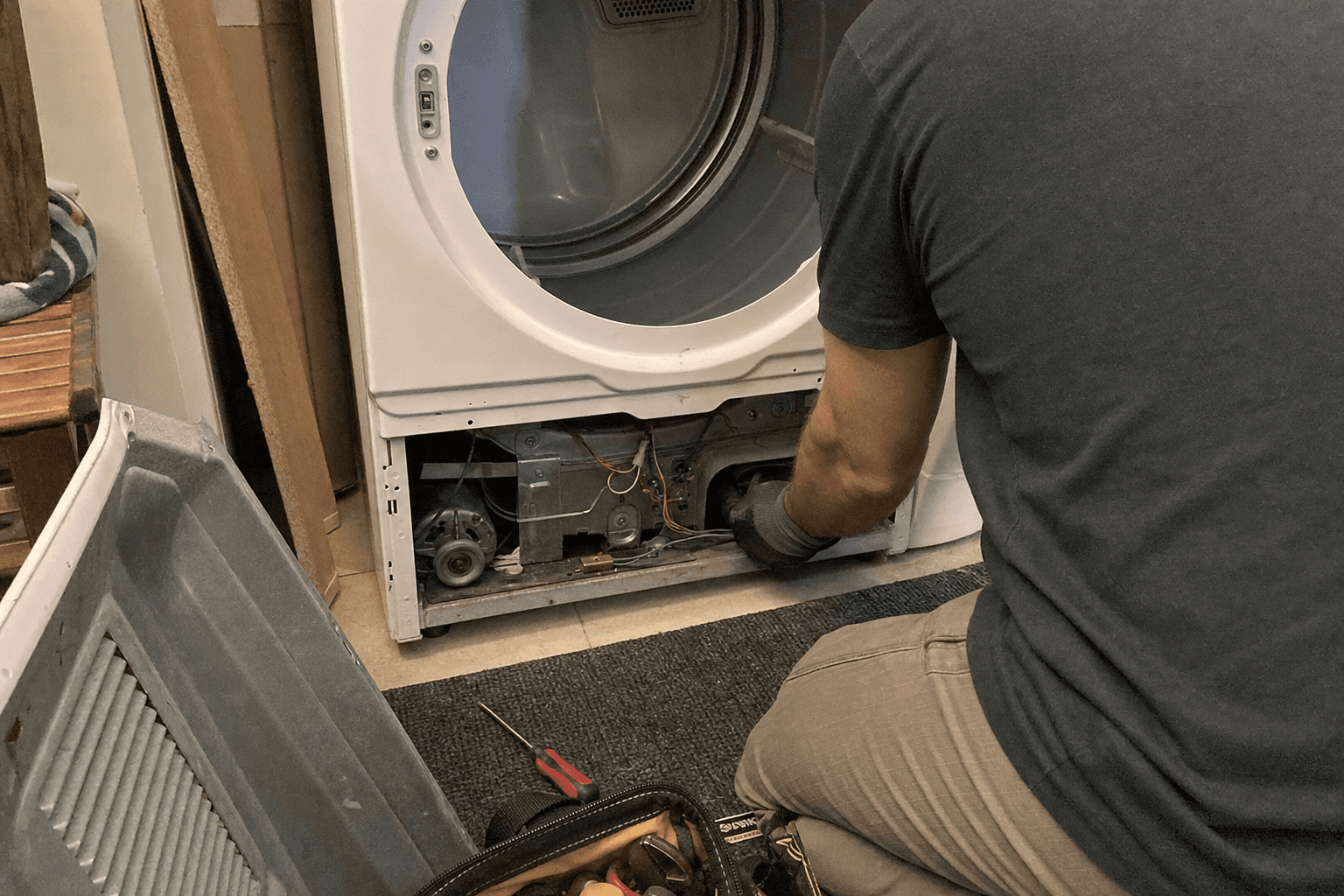
A technician will open the cabinet, check the belt, idler pulley, rollers and bearing, and find which part is worn. Often more than one part is tired, and replacing them together makes sense because the cabinet is already open.
Most dryer repairs in Metro Vancouver run $180 to $380 with parts. We give you an upfront quote on site. You do not pay unless we fix it, although the service call fee applies. Every repair carries a 90-day parts warranty and a 7-day satisfaction guarantee on the workmanship.
If your dryer is very old and the repair is near the top of that range, it is fair to weigh the cost against a replacement. We will tell you what we find and let you decide.
When to call a professional
Call a professional if the drum drags or scrapes when you turn it by hand, if the noise gets louder from week to week, or if you notice burning smells or heat problems. A squeak you can trace to a coin in the drum gap is yours to fix. Anything inside the cabinet is better left to a technician, who can find the worn part and replace it before it damages the drum or motor.
Need a hand from a real technician?
Our licensed pros repair washers and dryers across Metro Vancouver — same-day and next-day, with 90-day parts warranty + 7-day satisfaction guarantee.
Keep reading
What does agitator maintenance involve on a top-load washing machine?
Agitator maintenance is a short check you can do at home. Clean it, test that it sits tight, and listen for clicking. Here is what to look at and when a repair makes sense.
How much does it cost to fix a Samsung washer?
Most washer repairs in Metro Vancouver run $180 to $420 all-in, and a Samsung is no different. Here is what moves the price and how to get a fair quote.