What does agitator maintenance involve on a top-load washing machine?
Agitator maintenance is a short check you can do at home. Clean it, test that it sits tight, and listen for clicking. Here is what to look at and when a repair makes sense.
Key takeaways
- Agitator maintenance is a quick clean and check, done with the washer unplugged.
- Lint and soap residue around the base of the agitator cause most of the sticking and noise.
- A loose agitator, clicking, or clothes that barely move point to worn dogs or drive parts.
- Most washing machine repairs in Metro Vancouver run $180–$420 all-in, depending on the part.
Agitator maintenance is a short routine. Unplug the washer, wipe the agitator, clear lint and soap residue from around its base, check that it sits tight, and listen for odd noises when it runs. Do this a few times a year on a top-load washer. It takes about as long as wiping down the lid, and it catches small problems before they turn into a washer that won't wash.
This guide covers what to check, what you can safely do yourself, and which signs mean a part has worn out.
What the agitator does
The agitator is the post in the middle of a top-load washer drum. It twists back and forth and moves the clothes through the water. Front-load washers and many newer high-efficiency top-loaders don't have one. If your machine has a tall central post with fins or vanes, this guide applies to you.
Inside the base of the agitator are small plastic parts called agitator dogs. They grip the drive shaft and push the agitator in one direction, then let it slip back. When they wear down, the agitator stops moving properly even though the motor still runs.
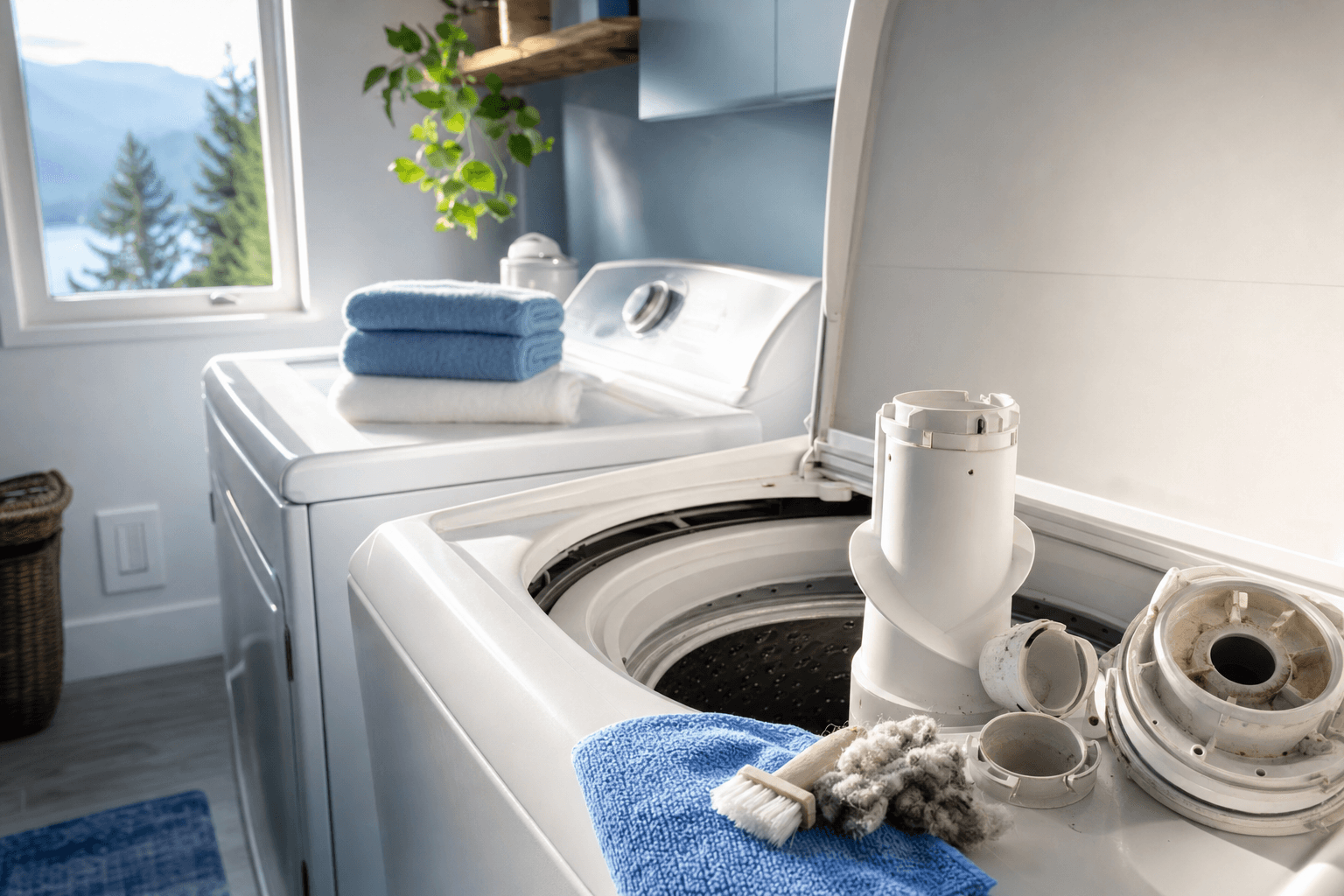
Agitator maintenance steps you can do at home
Start with the power off. Unplug the washer and make sure the drum is empty and dry.
- Wipe the outside of the agitator with a damp cloth and a little mild detergent.
- Pop off the top cap if your model has one, and clean under it. Soap and fabric softener build up here.
- Look around the base of the agitator for lint, hair, and sticky residue.
- Check for small items that slip down the sides, such as coins, buttons, and hair ties.
- Run a damp cloth around the top of the drum and under the lid.
- Look at the cap and fins for cracks or chips.
Use a soft cloth or an old toothbrush on tight spots. Skip sharp tools. A scratch or a nick in the plastic can catch fabric and tear it.
How to check that the agitator is working
With the power still off, hold the agitator by the top and try to turn it by hand. A healthy agitator moves a little in one direction and catches in the other. That is the dogs doing their job.
Now try a few simple tests.
Does it wobble?
Grip the agitator and gently rock it. A small amount of play is normal on some models. A lot of movement, or a clunk, usually means a loose mounting bolt or worn parts.
Does it spin freely both ways?
If it spins in both directions with no resistance, the dogs are likely worn or broken. The motor may run fine, but the agitator won't push the clothes.
Does it make noise when running?
Plug the washer back in and run a short cycle with a light load. A repeated clicking or ratcheting sound during agitation often points to worn dogs. Grinding or a burning smell means stop the cycle and unplug the machine.
Signs the agitator needs repair
Some problems are cleaning jobs. Others need a part. These signs usually mean a repair.
- Clothes come out barely moved, with soap still on them.
- The agitator turns by hand in both directions with no catch.
- The agitator is loose even after you tighten what you can reach.
- You hear clicking or ratcheting during the wash.
- The water fills and the motor hums, but nothing agitates.
- The agitator cap or fins are cracked.
A washer that agitates weakly can also have other causes, such as an overloaded drum or a worn belt. A technician can tell the difference quickly once the agitator is off.
Agitator maintenance in Richmond homes
Richmond sits on flat delta land near sea level, and the high water table keeps ground and concrete damp through the wet season. In neighbourhoods like Steveston, Broadmoor, and Seafair, many homes are older ranchers and two-storey houses. Washers there can be in service for a long time, so wear on the dogs and drive parts is common.
In Brighouse and across the City Centre condos and townhouse complexes, washers often sit in a closet or small laundry room. Lint and soap residue build up where air doesn't move much. A quick wipe-down after a heavy week of laundry helps.
A few habits help in any Richmond home.
- Keep the area around the washer dry and wipe up any damp.
- Don't overload the drum. A packed load forces the agitator to work harder.
- Measure detergent. Too much leaves residue that sticks to the agitator and drum.
- Take small items out of pockets before washing.
What not to do
Don't pry the agitator off with a screwdriver. Many agitators release with a bolt under the cap, or they pull straight up with a firm tug. Check your owner's manual for your model.
Don't run the washer with the agitator removed. Don't put your hand in the drum while it is moving.
When to call a professional
If the agitator is loose, spins freely, or clicks and the clothes aren't getting clean, it is time to call. Replacing worn dogs is a common repair, and it is easier when the cause is confirmed before parts are bought. Most washing machine repairs in Metro Vancouver run $180–$420 all-in, depending on the part. Our technician gives you an upfront quote on site before any work begins, and you don't pay unless we fix it, though a service call fee applies. Every repair is backed by a 90-day parts warranty and a 7-day satisfaction guarantee. If your washer is only dirty, a good clean is often all it needs.
Need a hand from a real technician?
Our licensed pros repair washers and dryers across Metro Vancouver — same-day and next-day, with 90-day parts warranty + 7-day satisfaction guarantee.
Keep reading
How much does it cost to fix a Samsung washer?
Most washer repairs in Metro Vancouver run $180 to $420 all-in, and a Samsung is no different. Here is what moves the price and how to get a fair quote.
How do sensor drying and timed drying affect results on a washer dryer?
Sensor drying stops when clothes are dry. Timed drying runs for the minutes you set. Here is how each affects dryness, fabric wear and energy use, and what to do when results are off.