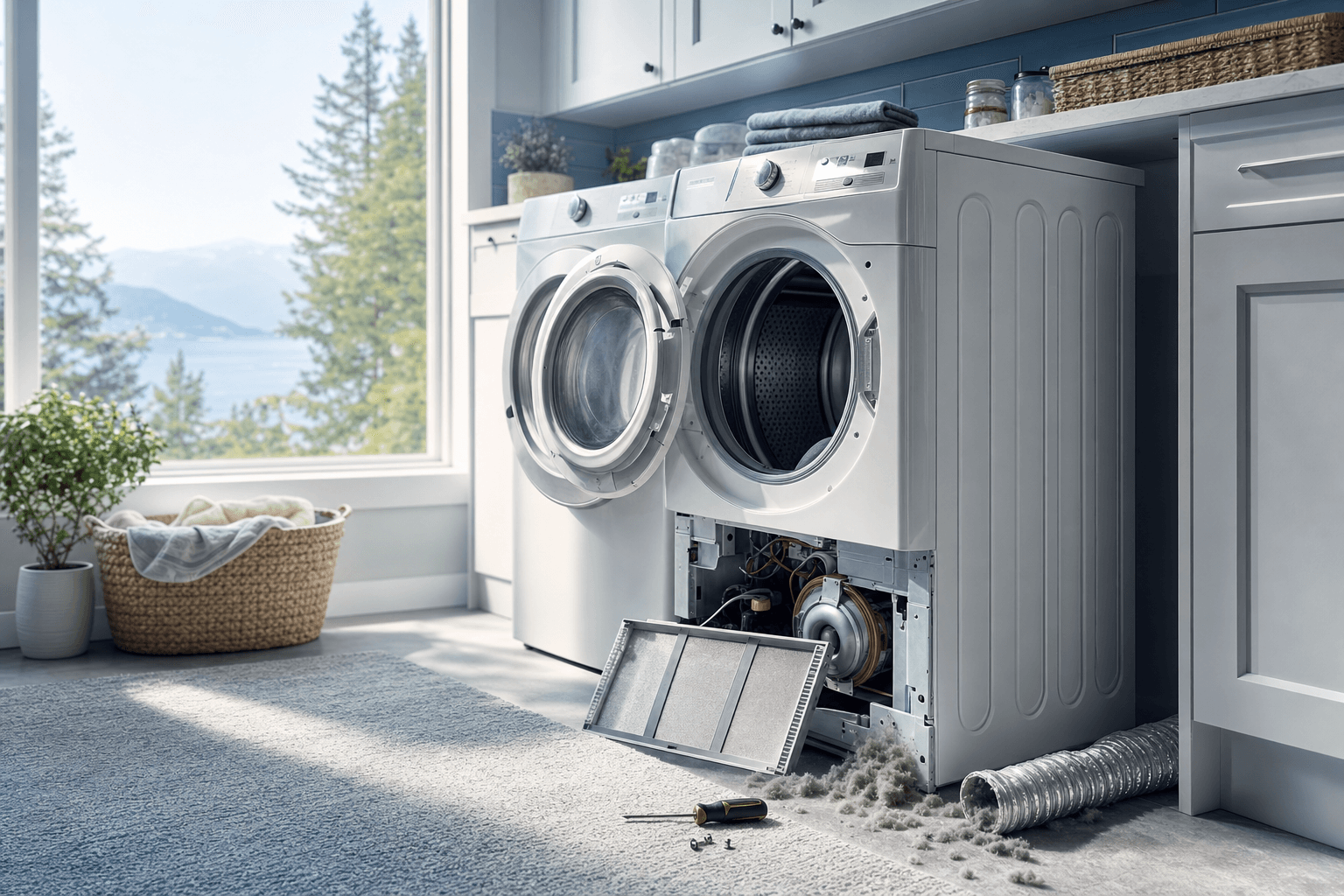
Why does my dryer shut off in the middle of a cycle?
A dryer that stops mid-cycle is usually overheating. Here is what to check first, what the repair usually involves, and when to call someone.
Key takeaways
- Mid-cycle shutoff usually means the dryer is overheating and a safety part is cutting power.
- A clogged vent is the most common root cause, so check the vent before you buy parts.
- Cedar and fir debris can block outside vent flaps on North Shore homes.
- A blown thermal fuse or bad thermostat is a small part, but the cause must be fixed too.
- Most dryer repairs in Metro Vancouver run $180–$380 with parts.
The short answer
A dryer that quits partway through a load is almost always getting too hot. Safety parts inside the dryer shut off the heat, or the whole machine, when the air gets past a safe temperature. The most common root cause is a clogged vent line. The hot, damp air can't leave, so the heat builds up.
That is good news in one way. Clearing the vent costs little and often fixes it. It also matters for safety, so it is worth doing before anything else.
What is happening inside the dryer
Your dryer has a few parts that watch the temperature.
- Thermostat. It opens and closes to keep the drum within a safe range. A weak or failed one can cut the cycle early.
- Thermal fuse. It is a one-time safety part. When it blows, the dryer may stop heating or may not start at all.
- Heating element. It makes the heat. A failing element can cause uneven heating or no heat.
When airflow is poor, the thermostat trips again and again. Clothes stay damp, the dryer clicks off, and you end up running extra cycles. If the thermal fuse blows, the dryer may tumble with no heat, or stay dead.
What to check first
Start with the easy checks. Do them with the dryer unplugged and fully cooled.
- Empty the lint screen. Do it before every load. If water beads on the screen, there is a film from dryer sheets or fabric softener. Wash the screen with warm soapy water and let it dry.
- Look at the load. A packed drum, or a load of heavy towels or bedding, blocks airflow. Try a smaller load.
- Check the outside vent flap. Go outside and look at the vent cap. It should open freely when the dryer runs. If it is stuck, packed with lint, or covered in debris, clean it.
- Check the vent hose behind the dryer. Pull the dryer out carefully and look at the hose. Crushed, kinked or lint-packed hose is common. Replace a damaged one.
- Run it again. If it now runs through a full cycle and dries normally, the vent was the problem.
If it still shuts off, the vent may be blocked further along the run, or a part has failed.
What to watch for in North Vancouver
North Vancouver is one of the wettest parts of the region, and the rain increases toward the mountains. That affects dryers in a few ways.
In Lynn Valley, Edgemont, Deep Cove and Canyon Heights, many homes sit under tall cedar and fir. Needles, moss and other debris can collect around the outside vent cap, especially in a wet November. Check it after windy or rainy weeks. Many of these are 1950s to 1970s post-and-beam houses and split-levels on sloped lots. The vent may exit high on a wall or at an awkward spot. Use a stable ladder and be careful on wet decks and steep ground.
If you live in a condo or an older walk-up around Lower Lonsdale, the vent may run a long way or connect to building ductwork. Ask your building manager before you open anything inside a wall. A long run collects lint faster, so the same symptoms can show up even when your own hose looks clean.
Damp fall air also means laundry often comes out wetter and clothes may take longer to dry. A dryer working harder than usual is more likely to trip a thermostat if the vent is already restricted.
When it is a part, not the vent
Sometimes the vent is clear and the dryer still stops. Then the likely causes are a failed thermostat, a blown thermal fuse, or a heating element on its way out.
These parts are not expensive by themselves. Most dryer repairs in Metro Vancouver run $180–$380 with parts. The final price depends on which part has failed and how hard it is to reach.
One point matters here. A thermal fuse blows for a reason. If a technician replaces it without finding why the dryer overheated, the new one can blow too. A proper repair includes checking the airflow, not only swapping the part.
What not to do
- Don't bypass or jump a thermal fuse or thermostat. They are there to prevent fires.
- Don't keep restarting a dryer that keeps shutting off. Heat can build up each time.
- Don't run the dryer if you smell burning. Unplug it and have it checked.
- Don't leave a dryer running while you are out of the house, especially if it has been acting up.
When to call a professional
Call a technician if you have cleaned the screen, the hose and the outside vent and the dryer still shuts off. Call too if you smell burning, if the vent is hard to reach, or if you are not comfortable pulling the dryer away from the wall. We give you an upfront quote on site, and you don't pay unless we fix it, though a service call fee applies. Every repair comes with a 90-day parts warranty and a 7-day satisfaction guarantee on the workmanship.
Need a hand from a real technician?
Our licensed pros repair washers and dryers across Metro Vancouver — same-day and next-day, with 90-day parts warranty + 7-day satisfaction guarantee.
Keep reading
What does agitator maintenance involve on a top-load washing machine?
Agitator maintenance is a short check you can do at home. Clean it, test that it sits tight, and listen for clicking. Here is what to look at and when a repair makes sense.
How much does it cost to fix a Samsung washer?
Most washer repairs in Metro Vancouver run $180 to $420 all-in, and a Samsung is no different. Here is what moves the price and how to get a fair quote.