Why does a dryer tumble but not heat, and what can you check first?
A dryer that spins but stays cold usually has a failed heating element, thermal fuse or thermostat. Here is what to check at home and what a repair usually costs.
Key takeaways
- Tumbling with no heat usually means a failed heating element, thermal fuse or thermostat.
- A clogged vent line is the most common root cause, so check it first.
- Electric dryers need two breaker poles, and one can trip while the drum still turns.
- Most Metro Vancouver repairs run $180 to $380 with parts.
- Unplug the dryer before you open any panel.
The short answer
A dryer that tumbles but stays cold is almost always missing heat for one of three reasons. The heating element has failed, the thermal fuse has blown, or the thermostat has stopped working. A clogged vent line is the most common root cause behind all three.
This is a common November complaint in Richmond. Laundry piles up, the dryer runs more, and a weak spot shows itself.
Why the drum can turn without heat
The motor and the heating system are separate. The motor turns the drum. The heating element, or the gas burner on a gas dryer, makes the heat. A safety fuse and thermostats sit between them to stop the dryer from overheating.
If any of those parts fails, the motor keeps running. You hear the drum, the clothes tumble, and nothing gets warm.
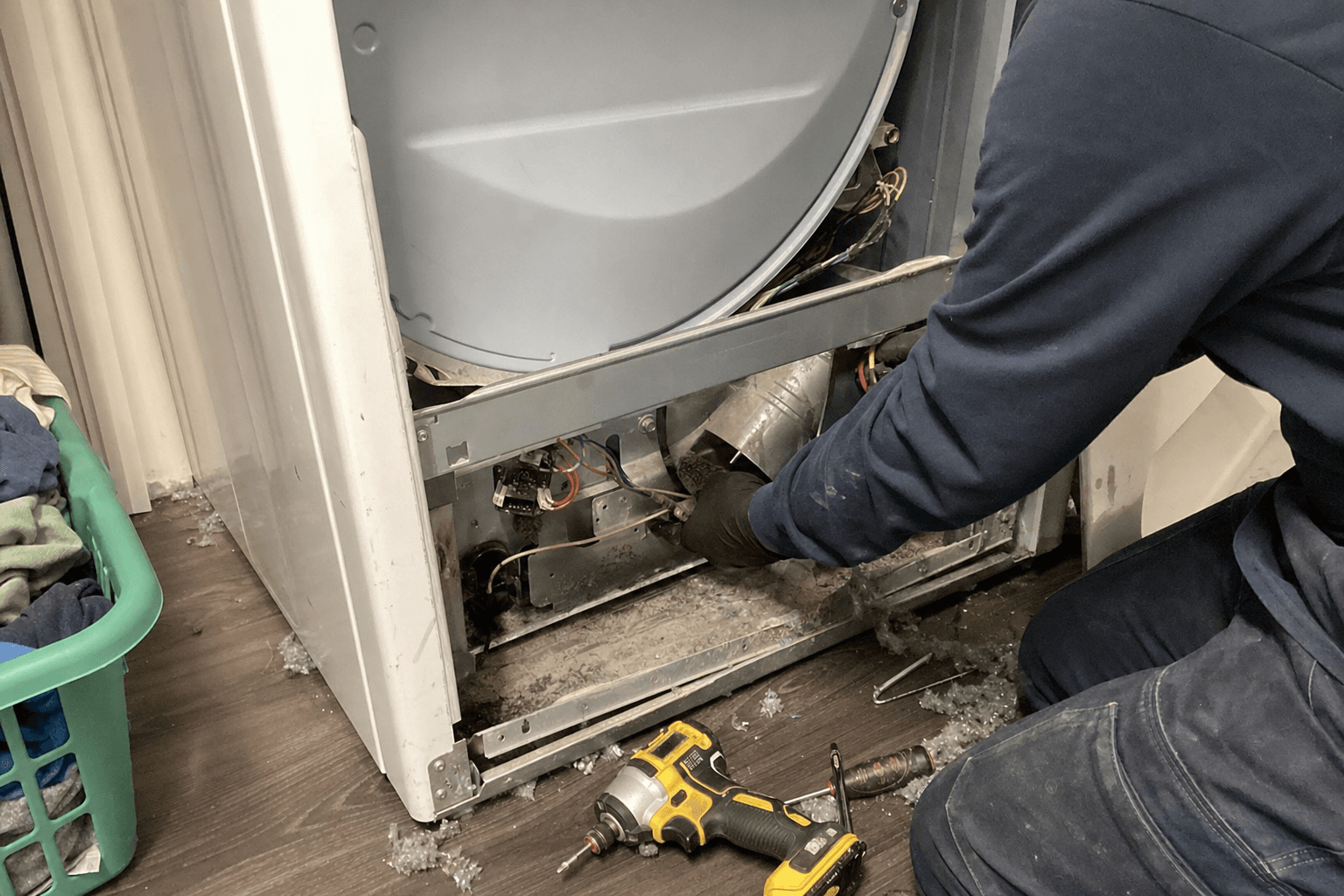
Restricted airflow is the usual trigger. When lint blocks the vent, hot air can't leave. The dryer runs hotter inside, the thermostat or fuse trips to protect it, and over time the element can burn out.
What to check first
Work through these in order. Each one takes only a few minutes and costs nothing.
- Check that the dryer is plugged in fully and the cord isn't pinched behind it.
- Check the breaker panel. An electric dryer uses a double breaker, and one side can trip while the drum still runs.
- Clean the lint screen and look for a film on the mesh. Wash it with warm water and dish soap if it looks waxy.
- Check the cycle setting. Make sure it isn't on air-only or a no-heat option.
- Run a small load and feel the air at the outside vent.
Check the vent line
Pull the dryer out carefully and look at the duct behind it. Crushed, kinked or lint-packed duct is the first thing to fix. Disconnect it and clear it by hand or with a brush made for dryer vents.
Then go outside and find the exterior hood. The flap should open freely when the dryer runs. If it hangs shut or is packed with lint, hot air stays inside the machine.
Check the breaker
Switch the dryer breaker fully off, then back on. If it trips again right away, stop. That points to a wiring or component fault and needs a technician.
The parts that usually fail
If the breaker and vent are fine, a part has likely failed. These are the usual suspects.
Heating element
The element is a coil of wire that glows to make heat. It can break or burn out after repeated overheating. A broken element is one of the most common reasons for a dryer that tumbles with no heat.
Thermal fuse
The thermal fuse is a one-time safety part. It blows if the dryer gets too hot, and it cuts power to the heat circuit. A blown fuse tells you something caused overheating, so the vent still needs a proper check. Replacing the fuse without clearing the vent means it can blow again.
Thermostat
Thermostats switch the heat on and off based on temperature. When one fails, the dryer may give no heat, or it may overheat and shut off mid-cycle.
Testing parts at home
If you are comfortable with a multimeter, you can test the element and fuse for continuity. Unplug the dryer first. For a gas dryer, shut off the gas supply too.
A part that shows no continuity has failed. Be careful with this step. Dryers carry high voltage and sharp sheet metal. If you smell gas or burning, don't keep testing. Unplug the machine and stop using it.
What a repair usually costs
Most dryer repairs in Metro Vancouver run $180 to $380 with parts. The final number depends on which part failed and how hard it is to reach. A quote before work starts means you know the cost before you agree to anything.
If your dryer is old and the quote is near the top of that range, it is fair to weigh the repair against a replacement. A vent that is fixed first matters either way.
Richmond notes
Richmond sits on flat delta land close to the water, and the wet season keeps everything damp. Wind off the Strait of Georgia can also push on exterior vents. That makes it worth checking that your outside hood flap moves freely.
In the older ranchers and two-storey homes in Broadmoor, Seafair and Blundell, the dryer often sits against an outside wall. The duct is short and easy to reach. In the large new houses that have replaced many of them, the laundry room may be on an upper floor, and the vent run can be longer.
In the condo towers around Brighouse, and in townhouse complexes in Terra Nova, Hamilton and Steveston, the vent route can look different. Follow the duct from the back of the dryer to the wall and see where it leaves your unit. If you can't reach the outside end, ask your strata or building manager who handles it.
When to call a professional
Call a technician if the breaker trips again, the element or fuse tests bad, or you smell burning. Call too if you can't reach the vent or don't want to open the dryer. We repair dryers across Richmond and Metro Vancouver, with an upfront quote on site. You don't pay unless we fix it, though a service call fee applies. Every repair carries a 90-day parts warranty.
Need a hand from a real technician?
Our licensed pros repair washers and dryers across Metro Vancouver — same-day and next-day, with 90-day parts warranty + 7-day satisfaction guarantee.
Keep reading
What does agitator maintenance involve on a top-load washing machine?
Agitator maintenance is a short check you can do at home. Clean it, test that it sits tight, and listen for clicking. Here is what to look at and when a repair makes sense.
How much does it cost to fix a Samsung washer?
Most washer repairs in Metro Vancouver run $180 to $420 all-in, and a Samsung is no different. Here is what moves the price and how to get a fair quote.