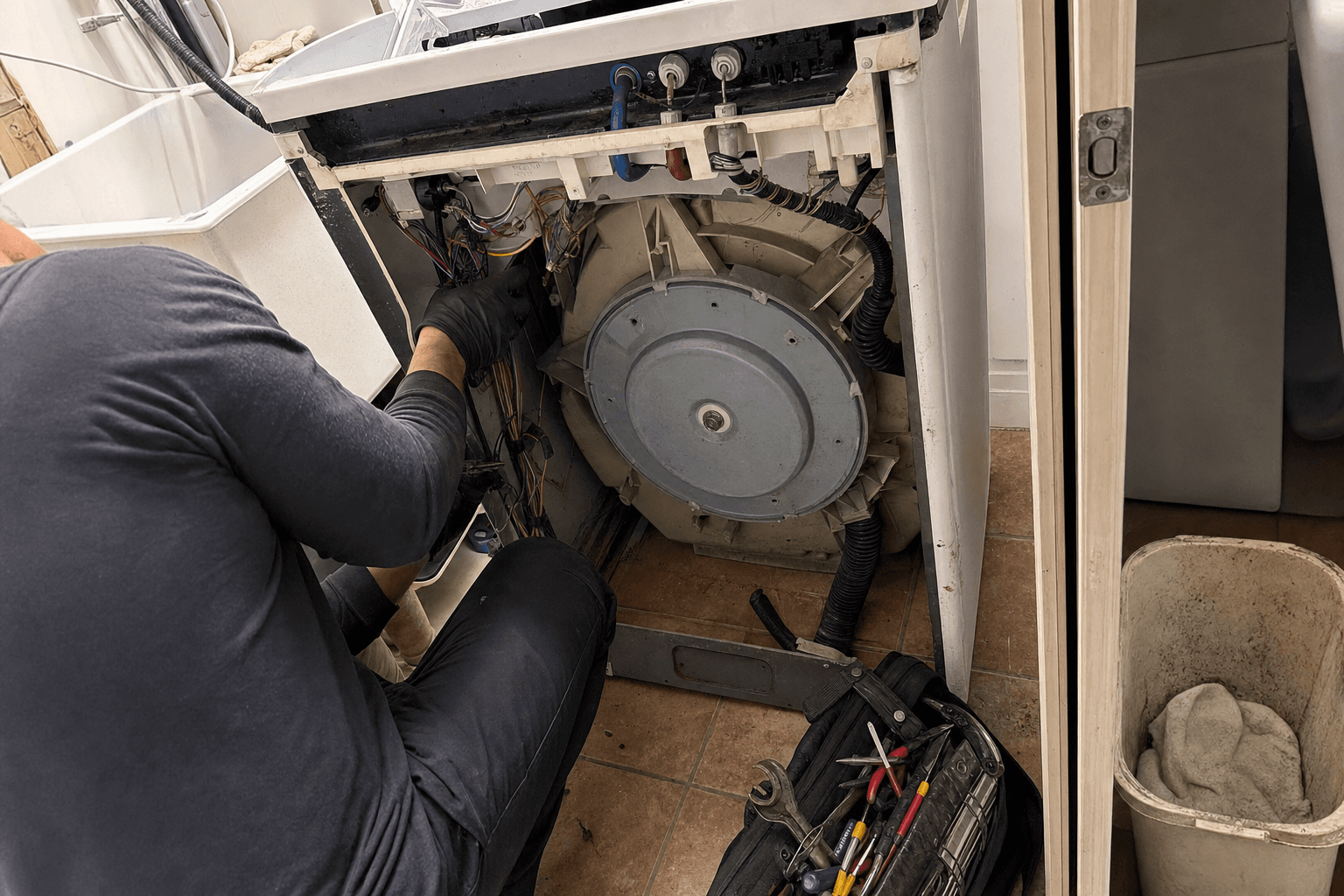
What does a washing machine error code mean, and what can you fix yourself?
An error code names the part of the washer that failed. Here is how to read it, what you can safely check at home, and when the code means a repair.
Key takeaways
- An error code points to one system, not always to one broken part.
- Your manual or the sticker inside the door gives the exact meaning for your brand.
- Power off, check hoses, filter and load first. Those fixes cost nothing.
- A code that returns after a reset usually means a failed part.
- Shut off the water and unplug the machine if you see leaking or a burning smell.
What an error code actually tells you
An error code is the washer telling you which system it thinks has a problem. It does not always name the broken part. A drain code, for example, can come from a clogged filter or from a failed pump.
The codes differ by brand and model. A set of letters on one machine can mean something else on another. The manual or the sticker inside the door or lid is the only reliable way to read yours.
Most codes fall into five groups.
- Water in. The washer is not filling, or is filling too slowly.
- Water out. The washer cannot drain, or drains too slowly.
- Door or lid lock. The machine cannot confirm the door is closed and locked.
- Unbalanced load. The drum is shaking too much to spin up.
- Power or motor. The control board or the drive motor is reporting a fault.
Step 1: Write down the code and reset the machine
Write down exactly what the display shows before you do anything. If it flashes, count the flashes.
Then turn the washer off and unplug it for a few minutes. Plug it back in and run a short cycle. Some codes come from a one-time glitch, such as a power flicker, and clear on their own.
If the same code comes back, move on to the checks below.
Step 2: Match the code group to a simple check
Water in codes
Check that both tap valves behind the machine are fully open. Pull the machine out a little and look at the hoses for kinks. Unscrew each hose from the back of the washer and look for grit on the small screen inside the inlet. A clogged screen is a common reason for slow filling.
If your washer sits in a garage or an unheated space, cold nights can affect how fast it fills. Inland areas like Cloverdale get slightly colder winter nights than the coast, so this is worth keeping in mind.
Water out codes
Look for a standing puddle in the drum. If there is water, the machine cannot drain. Check the drain hose for a kink behind the washer. Then find the drain pump filter, usually behind a small panel at the bottom front of a front-loader. Put a towel and a shallow dish down first, because water will come out. Clear out lint, coins, and hair ties.
If the filter is clean and the hose is straight, the drain pump may have failed. That needs a repair.
Door or lid lock codes
Close the door firmly and check that nothing is caught in the seal, like a sock or a strap. Wipe the latch area. If the door closes but the code stays, the lock assembly or its switch is likely worn.
Unbalanced load codes
Open the door, redistribute the load, and take out anything heavy and soaked, such as a single towel or a bath mat. Check that the machine sits level and that all four feet touch the floor. Many Surrey homes have older concrete or sloped basement floors, such as the 1970s and 1980s split-levels and basement-entry homes in Newton, Guildford and Fleetwood. A washer that rocks on an uneven spot will throw this code often.
If the load is even and the machine is level but it still bangs on spin, the shock absorbers or suspension may be worn.
Power or motor codes
There is very little to check here. Confirm the outlet works by plugging in a lamp. Make sure the plug is fully seated. If the code is about the motor or the control board, a technician needs to test it.
What you should not do
Do not keep restarting a machine that shows the same code over and over. Repeated cycles can leave water in the drum or strain a part that has already failed.
Do not open the back panel while the machine is plugged in. Do not bypass a door lock.
If you see water pooling under the washer, shut off both taps and unplug it. This matters most in strata townhouses, which make up a large share of recent construction in areas like Clayton Heights. A leak on an upper floor can reach a neighbour's unit quickly.
What a repair usually costs
Most washing machine repairs in Metro Vancouver run $180 to $420 all-in. The final number depends on the part. A drain pump, a door lock and a control board are not the same price.
Our technician gives you an upfront quote on site before any work begins. If we do not fix it, you do not pay, though the service call fee applies. Every repair carries a 90-day parts warranty and a 7-day satisfaction guarantee on the workmanship.
If your machine is old and the quote is close to the price of a new one, ask the technician for an honest view on whether the repair is worth it.
When to call a professional
Call a technician if the code returns after a reset and the simple checks, if you see leaking water, or if you smell something burning. Call too if the code points to the motor, the control board or the door lock, since those parts need testing and the right replacement.
If you have run through the checks above and the code is still on the display, a technician can usually tell you the cause quickly. We offer same-day visits when available, seven days a week, for homes across Surrey and the rest of Metro Vancouver.
Need a hand from a real technician?
Our licensed pros repair washers and dryers across Metro Vancouver — same-day and next-day, with 90-day parts warranty + 7-day satisfaction guarantee.
Keep reading
Why your washing machine won't start and what to check first
A washer that is dead or won't start often has a simple cause. Here is what to check, in order, before you decide whether to book a repair.
How often should you clean your dryer vent?
Most homes need a dryer vent cleaning once a year. Long runs, multi-unit buildings and heavy laundry loads mean every 6 to 9 months. Here is how to tell which you are.