Why your washer fills with cold water in November—and when to worry
As Metro Vancouver's autumn rains set in, some washers stop heating water properly. Here's how to tell if it's a real problem or just a seasonal quirk.
Key takeaways
- Always verify your dial or app shows the correct water temperature—dial drift happens in older machines.
- Mineral buildup from Metro Vancouver's hard water blocks heating elements; descaling may restore heat.
- A failed thermostat or heating element requires professional replacement; DIY fixes risk electrical damage.
- November is ideal for repairs—winter demand makes scheduling harder and parts take longer to arrive.
- Test with a small load of towels before committing to a full repair to rule out user error.
November in Coquitlam brings rain, cooler air, and a peculiar washing machine complaint: water that should arrive hot comes out cold. Before you panic or call for service, it helps to understand why this happens now and which fixes you can tackle yourself.
Check your settings first
The most common culprit is operator error, not a broken machine. On dial machines, the temperature selector can drift slightly from friction or vibration, especially after years of use. On digital displays, a mistap or a child's exploration can change the default. Start by running a small test load—a few hand towels—on your hottest setting and feel the water as it enters the tub. If it's genuinely cold, move to the next step. If it's warm, you've likely found your answer.
Hard water and mineral buildup
Metro Vancouver's water is moderately hard, meaning it carries dissolved minerals that accumulate in heating elements and thermostats over time. As November's cooler air arrives, your machine works harder to heat water, and a partially clogged element struggles to do the job. You may notice water heating inconsistently—hot on one cycle, lukewarm on the next.
A commercial washing machine descaler (available at most hardware stores) can help. Run a cycle with the descaler and no clothes, then two empty hot cycles to rinse. This won't fix a truly failed element, but it often restores heating in machines that are simply slow or unreliable.
When you need a professional
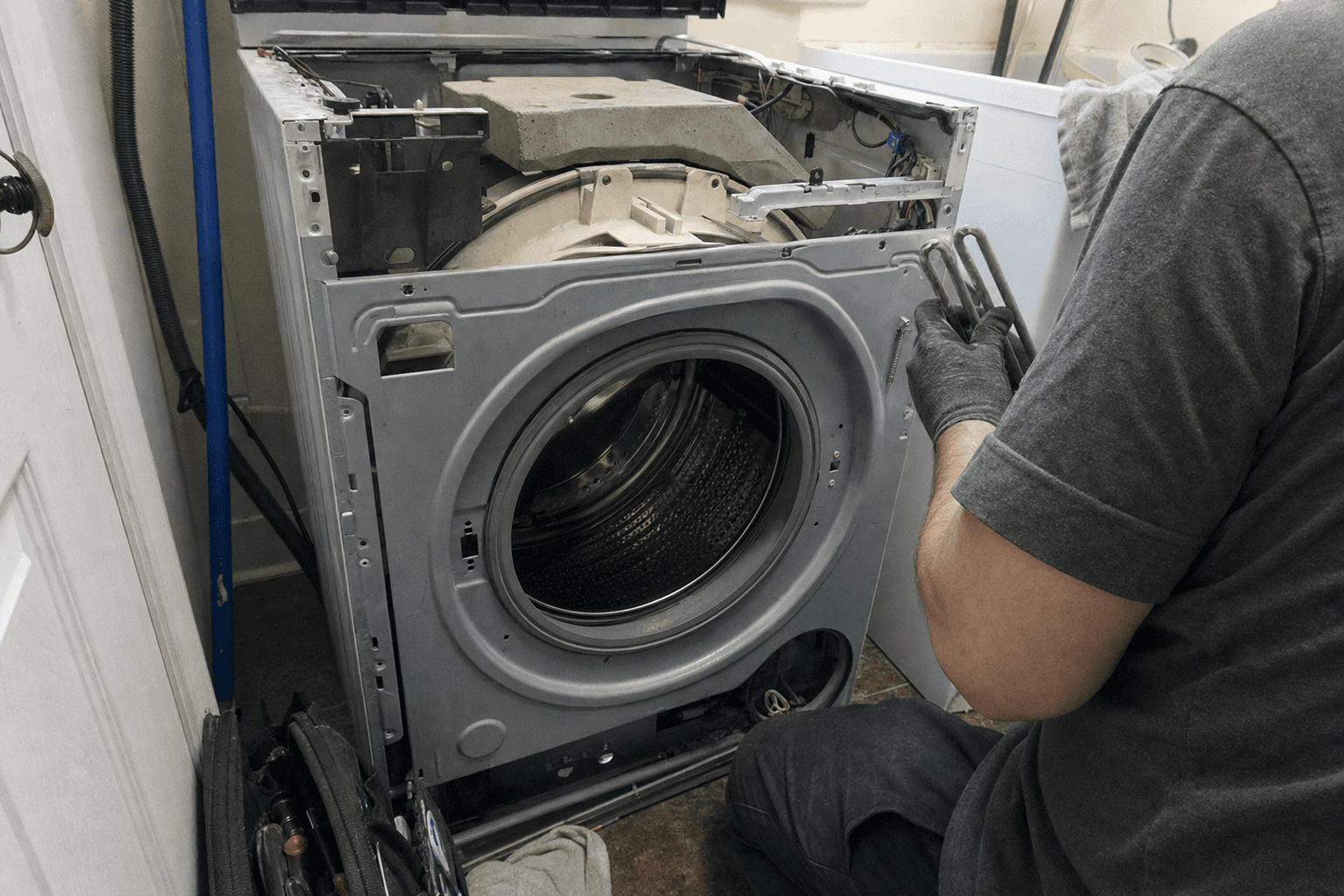
If descaling doesn't help, the thermostat or heating element itself has likely failed. These are not safe DIY repairs—water heating involves electrical components, and mistakes can cause shock or fire. A technician can diagnose which part is at fault and replace it properly.
November is actually the best time to schedule this work. Winter demand (December through February) makes it harder to book appointments, and parts can take longer to arrive when everyone's systems are failing at once. A repair now means you'll have reliable hot water for the heavy laundry season ahead.
A quick diagnostic trick
Fill a kettle from your washing machine's hot-water inlet tap (usually under the sink or behind the machine). If that water is hot, your home's water heater is fine—the problem is in the washer itself. If the tap water is also cold or lukewarm, your home's hot-water system may be the issue, and you'll want to check your water heater before blaming the machine.
Don't ignore this problem heading into winter. Hot water is essential for sanitizing bedding, towels, and work clothes, and a broken heating element only gets worse as the season progresses.
Need a hand from a real technician?
Our licensed pros repair washers and dryers across Metro Vancouver — same-day and next-day, with 90-day parts warranty + 7-day satisfaction guarantee.
Keep reading
Why your washing machine won't start and what to check first
A washer that is dead or won't start often has a simple cause. Here is what to check, in order, before you decide whether to book a repair.
How often should you clean your dryer vent?
Most homes need a dryer vent cleaning once a year. Long runs, multi-unit buildings and heavy laundry loads mean every 6 to 9 months. Here is how to tell which you are.