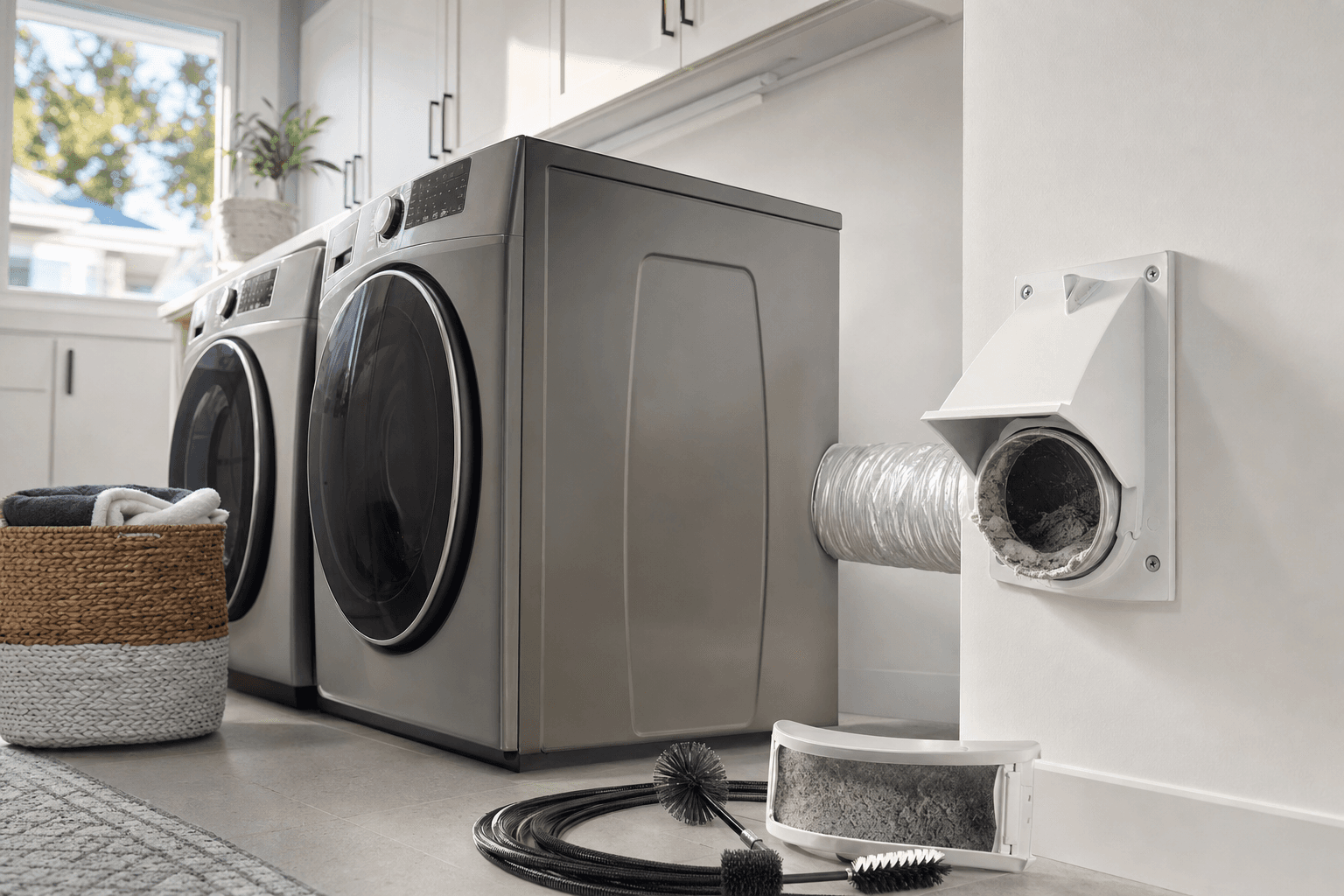
How do you clean a dryer vent line, and how do you know it's clogged?
A clogged vent line is the most common root cause of a dryer that runs hot, dries slowly or stops heating. Here is how to check it and clean it yourself, step by step.
Key takeaways
- A clogged vent is the most common root cause of a dryer that stops heating.
- Weak airflow at the outdoor hood is the quickest test for a blockage.
- Unplug the dryer first, and leave gas connections to a professional.
- Check the vent whenever drying slows down, not only when the dryer fails.
- Most dryer repairs in Metro Vancouver run $180 to $380 with parts.
Why the vent line matters
Your dryer pushes hot, damp air out through a duct to the outside of your home. Lint travels with that air. Over time some of it sticks to the duct walls and builds up.
When the duct narrows, the air can't leave. The dryer runs hotter, clothes stay damp, and parts that protect the machine start to fail. A clogged vent line is the most common root cause when a dryer tumbles but won't heat. The part that fails is usually the heating element, thermal fuse or thermostat.
Cleaning the vent is a job most homeowners can do in under an hour with basic tools.
Signs the vent line is clogged
The dryer usually tells you before it quits. Look for these.
- Clothes need more than one cycle to dry.
- The top or side of the dryer feels very hot.
- The laundry room feels humid or warm after a load.
- The dryer shuts off mid-cycle and restarts after it cools.
- A hot or burning smell during a cycle.
- The flap on the outside vent barely lifts, or doesn't lift at all.
A burning smell needs attention right away. Stop the dryer, unplug it and check the vent before you run another load.
A quick test at the outdoor hood
Start the dryer on a high-heat setting. Go outside and hold your hand near the vent hood.
You should feel a steady push of warm air, and the flap should stay open. If the air is weak, the flap flutters or nothing comes out, the blockage is somewhere between the dryer and the wall.
This test takes two minutes and tells you whether cleaning will help.
What you need
- A vacuum with a hose attachment
- A flexible dryer vent brush with extension rods
- A screwdriver or nut driver for the clamps
- Foil tape for reconnecting joints
- Gloves and a dust mask
A drill-driven brush speeds things up, but a hand-turned one works fine.
How to clean the vent line
Unplug the dryer and pull it out
Unplug the dryer. Pull it forward slowly so you don't crush the duct or strain the cord. If you have a gas dryer, don't pull it far and don't disturb the gas line. Leave that to a professional.
Disconnect the duct
Loosen the clamp at the back of the dryer and slide the duct off. Do the same at the wall end if you can reach it. Shake out any loose lint into a bag.
If the duct is soft foil or white plastic and is sagging or crushed, replace it. Rigid or semi-rigid metal duct holds its shape and sheds lint better.
Clean the dryer outlet and the duct
Vacuum the opening at the back of the dryer. Then push the brush into the duct from one end and work it through in short passes. Pull it out and clean off the lint often. Finish by vacuuming the duct.
Clean the outdoor hood
Go outside and clear lint from the hood and flap. Check that the flap moves freely. Remove any bird nesting material or leaves. Don't leave a screen on the hood, since lint clogs it quickly.
Reconnect and test
Reattach the duct with clamps and seal joints with foil tape, not screws that poke into the duct. Screws catch lint. Push the dryer back without kinking the duct, plug it in and run a heat cycle. Repeat the hand test at the hood.
Empty the lint trap before every load. Wash it now and then with warm water and a soft brush if dryer sheets have left a film on the screen.
What to expect in Surrey homes
The layout of your home changes how hard this job is.
In the 1970s and 1980s split-levels and basement-entry homes in Newton, Guildford and Fleetwood, the laundry is often in the basement or lower level. The duct may run a long way along a ceiling or through a joist space to reach an outside wall. Long runs with several bends collect more lint, so they need more passes with the brush.
In larger newer homes on Panorama Ridge and in Morgan Creek, the laundry may be on an upper floor and the duct may run through a wall or the roof space. These runs can be hard to reach from either end.
Strata townhouses, which are common in Clayton Heights, often have a short duct to an exterior wall. They can still clog. Check your strata rules before you change or replace the outdoor hood, because the exterior may be shared property.
Many detached homes in Surrey also have suites. If two dryers share a space or a vent path, check both before you assume the fault is in one machine.
Why autumn is a good time to check
It rains through November, and inland areas such as Cloverdale see colder nights than the coast. Damp, cool air in a long duct can leave lint heavier and stickier. A vent that was borderline in summer can start to struggle once the weather turns and you run the dryer more often.
Check the vent at the start of the wet season. After that, look at it any time drying slows down.
What a clog can cost you
A blocked vent forces the dryer to run hot. The thermal fuse or thermostat can trip, and the heating element can burn out. Most dryer repairs in Metro Vancouver run $180 to $380 with parts, depending on which part has failed.
Cleaning the vent first costs far less. It also protects the new part if a repair is needed.
When to call a professional
Call a professional if the duct is hidden in a wall or ceiling, if you can't reach the blockage, or if your dryer is gas. Call if the dryer still won't heat after the vent is clear, since the element, fuse or thermostat has probably failed. If you smell burning or the dryer keeps shutting off, stop using it and book a visit. We quote upfront on site, and you don't pay unless we fix it, though a service call fee applies.
Need a hand from a real technician?
Our licensed pros repair washers and dryers across Metro Vancouver — same-day and next-day, with 90-day parts warranty + 7-day satisfaction guarantee.
Keep reading
Is it worth repairing a dryer that stopped heating, or should you replace it?
A dryer that tumbles but won't heat is often worth fixing. Here is how to weigh repair cost against replacement, and what to check before you decide.
Why won't my dryer start, and what can you check before calling for repair?
A dryer that won't start or won't tumble usually has a power, door switch, or safety fuse problem. Here is what to check in order, what it costs, and when to call.