Why your washing machine's water inlet valves clog in summer—and how to flush them
Summer's mineral-rich water and heat stress your washer's inlet valves. Learn to spot the signs and clear the blockage before it becomes costly.
Key takeaways
- Inlet valve screens trap sediment and minerals; summer heat accelerates buildup in Metro Vancouver's hard water.
- Slow water entry, partial cycle failures, and uneven wash results signal a clogged inlet valve.
- Turn off the water supply, remove hose connections, and rinse screens under running water to clear debris.
- Clean inlet valves every 12 months; more often if you have heavy sediment or live in a hard-water area.
- Sediment filters on your supply lines prevent future clogs and protect your washer's internal components.
What happens inside your inlet valve in summer
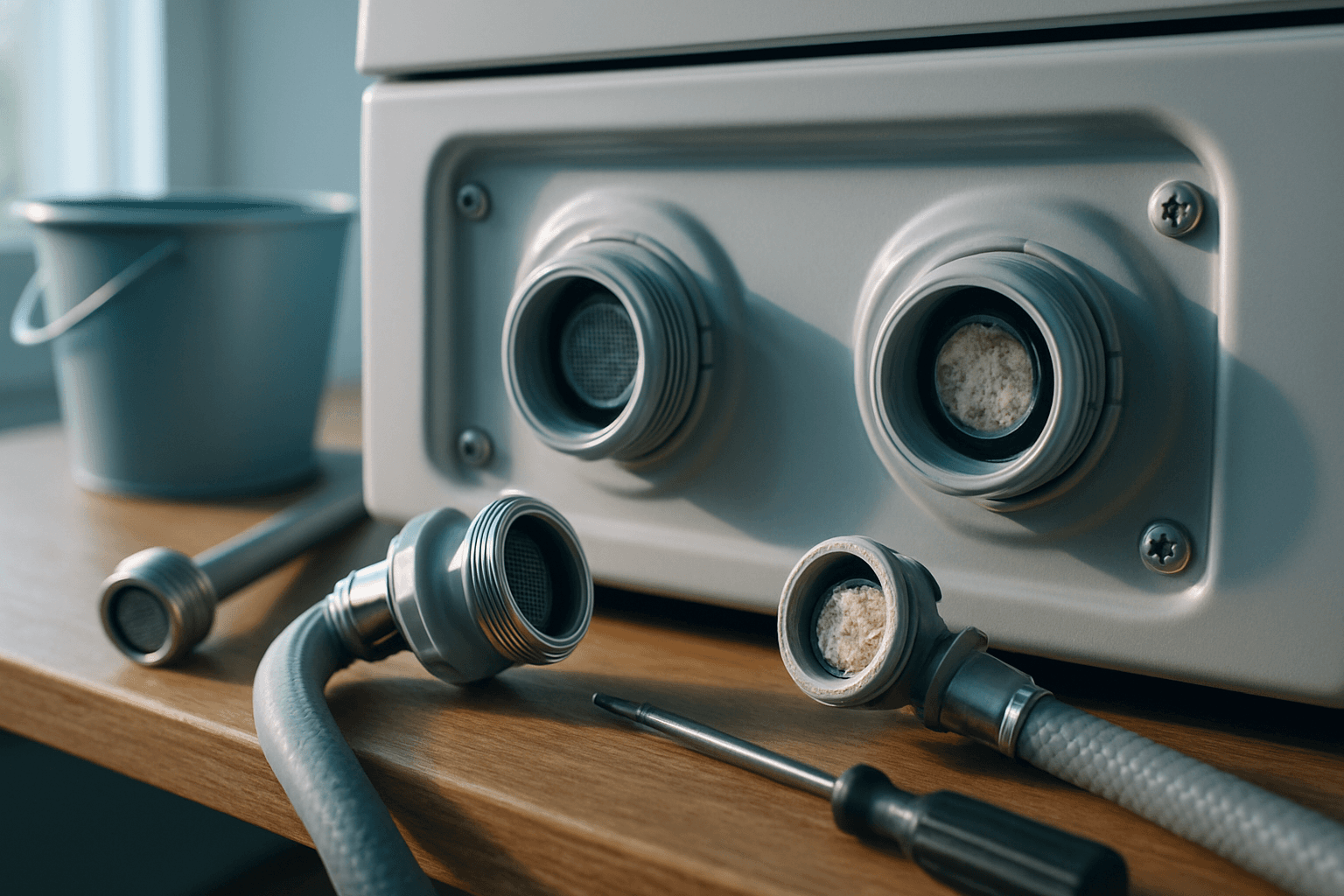
Your washing machine has two inlet valves—one for hot water, one for cold—that control water flow into the drum. Inside each valve is a small mesh screen designed to catch sediment before it enters your machine. In summer, when Metro Vancouver's water heats up and mineral content peaks, calcium and magnesium deposits build up on those screens faster than usual. The warm water also makes hard-water minerals more likely to precipitate and stick.
Over a few months, the screen becomes so clogged that water trickles in instead of flowing freely. Your washer then struggles to fill the drum completely or within the expected time.
Signs your inlet valve needs flushing
Watch for these telltale symptoms:
**Slow water entry.** The drum fills noticeably slower than it used to, even on a normal cycle. You might hear the valve humming as it tries to push water through the blockage.
**Partial or failed cycles.** Your washer starts a cycle but stops mid-wash because it didn't fill enough to trigger the next stage. Some machines display an error code; others just sit idle.
**Uneven wash results.** Clothes come out dirtier on one side of the load, or detergent residue remains because the water level was too low to rinse properly.
**Water leaking from the hose connection.** Pressure builds up behind the clog, and old washers or weakened hose connections may weep or spray.
If you notice any of these, a clogged inlet valve is often the culprit—and it's one of the easiest repairs to tackle yourself.
How to clean your inlet valve screens
This job takes 15 minutes and requires only a flathead screwdriver, a bucket, and running water.
**Step 1: Turn off both water taps.** Locate the isolation valves behind your washer (one for hot, one for cold). Turn both clockwise until they stop. If you can't find them or they won't turn, shut off the main water supply to your home.
**Step 2: Disconnect the inlet hoses.** Unscrew the hose nuts where they connect to the back of the washer. Have a bucket ready—there may be a little water inside. Set the hoses aside.
**Step 3: Remove and rinse the screens.** Look inside the washer's inlet ports (the openings where the hoses were connected). You'll see small mesh screens. Use a flathead screwdriver to gently pry them out. Rinse each screen under warm running water, rubbing away any white, tan, or orange sediment. If the buildup is heavy, soak the screens in white vinegar for 10 minutes first.
**Step 4: Rinse the inlet ports.** Use a clean cloth to wipe inside each port, removing any loose sediment.
**Step 5: Reinstall and reconnect.** Pop the screens back into their ports (they should sit flush), then screw the hoses back on firmly. Turn the water taps back on and run a test cycle to confirm normal water flow.
Preventing future clogs
After cleaning, consider installing **inlet hose screens or sediment filters** on your supply lines. These inexpensive mesh filters catch particles before they reach your washer's valves. In Maple Ridge and across the Lower Mainland, where hard water is common, these filters are a worthwhile investment.
Clean your inlet valve screens every 12 months as part of routine maintenance. If you have sediment issues or notice rust-coloured water from your taps, bump that to twice a year.
If you've cleaned the screens and your washer still fills slowly, the valve solenoid itself may have failed—a job best left to a technician. But nine times out of ten, a simple screen cleaning restores your machine to full performance.
Need a hand from a real technician?
Our licensed pros repair washers and dryers across Metro Vancouver — same-day and next-day, with 90-day parts warranty + 7-day satisfaction guarantee.
Keep reading
Halloween candy wrappers and dryer fires: why your lint trap needs daily checks now
October's trick-or-treat season means sticky fingers, wrapper debris, and a hidden fire hazard in your dryer. Here's what Burnaby homeowners need to know.
Costume cleanup: why your washer's cold-water cycle needs a pre-rinse now
Halloween costumes bring mud, fake blood, and stubborn stains. Here's why a quick pre-rinse before the main wash saves your machine—and your clothes.